🌍 Introduction: A Question as Old as Humanity
“Does God exist?”
This question has been asked by philosophers, scientists, thinkers, and ordinary people throughout history. In the modern world, especially with the rise of science and materialism, many people identify as atheists and reject the idea of God altogether.
Islam does not ignore this question. In fact, the Qur’an directly addresses human doubt, reason, observation, and intellect. Rather than demanding blind belief, Islam invites people to think, reflect, and question.
This article explores:
- what atheists commonly argue
- how the Qur’an responds
- how the Sunnah explains belief in God
- and why belief in God is both rational and natural
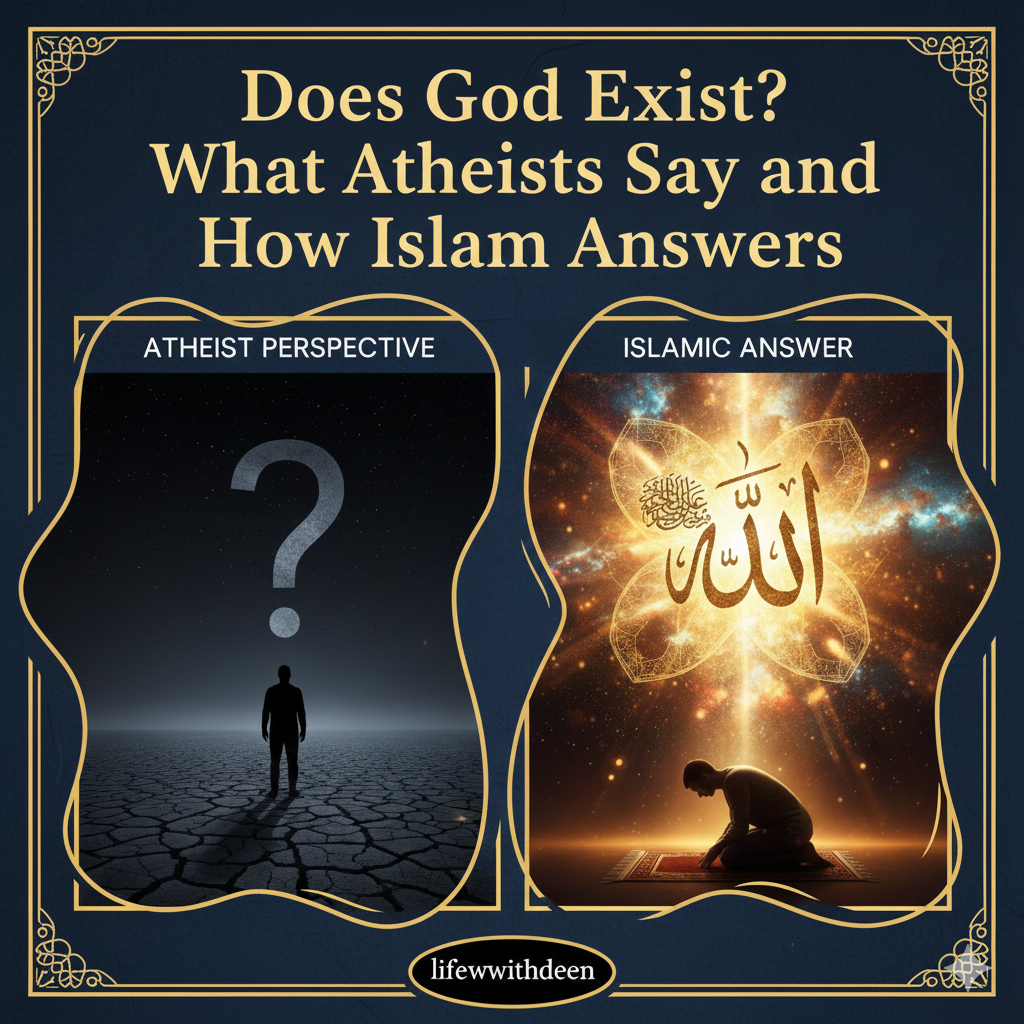
🧠 What Do Atheists Say About God?
Does God exist? Atheism generally means denying the existence of God. While atheists differ in views, some common arguments include:
1️⃣ “There Is No Evidence for God”
Many atheists argue that since God cannot be physically seen or measured, His existence cannot be proven scientifically.
They rely heavily on empirical evidence—what can be tested, observed, and repeated in experiments.
2️⃣ “Science Explains Everything”
Another common claim is that:
- the universe began through natural processes
- life evolved without divine intervention
- laws of physics explain existence
Therefore, they argue that God is unnecessary.
3️⃣ “Does God Exists, Why Is There Suffering?”
Atheists often point to:
- wars
- natural disasters
- disease
- injustice
and ask:
“Why would a good God allow this?”
This is known as the problem of evil.
4️⃣ “Religion Is a Human Invention”
Some atheists claim that belief in God was created by humans: Does God exist:
- to control society
- to cope with fear of death
- to explain the unknown
According to this view, God is a psychological or social construct.
🌙 How the Qur’an Responds: A Rational Invitation
The Qur’an does not mock doubt. It responds logically and directly.
📖 1️⃣ “Were They Created From Nothing?”
Allah asks one of the most powerful questions in the Qur’an:
“Were they created by nothing, or were they themselves the creators?”
(Qur’an 52:35)
This verse presents three possibilities: Does God exist?
- Humans came from nothing
- Humans created themselves
- Humans were created by a Creator
The first two are logically impossible. Nothing cannot create something, and something cannot create itself.
This leaves only one rational conclusion: a Creator exists.
🌌 The Universe: Design or Accident? Does God exist?
The Qur’an repeatedly invites humans to observe the universe:
“Indeed, in the creation of the heavens and the earth… are signs for people who reflect.”
(Qur’an 3:190)
The universe operates with:
- precise laws
- mathematical order
- fine-tuned constants
If these values were slightly different, life would be impossible. The Qur’an argues that such precision points to intentional design, not blind chance.
🧬 Science and God: Conflict or Harmony?
Islam does not reject science. In fact, it encourages knowledge.
But the Qur’an makes a clear distinction:
- science explains how things work
- God explains why they exist
Science describes processes.
God explains purpose.
Knowing how a phone works does not deny the existence of the manufacturer. Similarly, understanding nature does not deny the Creator.
🤍 The Problem of Suffering: An Islamic Perspective
Islam answers the question of suffering differently.
The Qur’an explains that:
- life is a test
- hardship is part of moral responsibility
- free will allows both good and evil
“He who created death and life to test you as to which of you is best in deeds.”
(Qur’an 67:2)
Without hardship:
- patience has no meaning
- justice has no value
- compassion has no purpose
Islam does not say suffering is meaningless—it says it is temporary and accountable.
Ultimate justice, Islam teaches, is not in this world but the Hereafter.
🧠 Belief in God Is Natural (Fitrah)
Islam teaches that belief in God is part of human nature (fitrah).
The Qur’an says:
“So direct your face toward the religion, inclining to truth—the natural disposition upon which Allah has created mankind.”
(Qur’an 30:30)
This explains why:
- people instinctively pray in danger
- humans search for meaning
- morality feels objective
Atheism often requires suppressing this inner instinct, while belief aligns with it.
🌙 What the Sunnah Teaches About Knowing God
The Prophet Muhammad ﷺ emphasized reflection, not blind belief.
He encouraged:
- thinking about creation
- reflecting on purpose
- observing signs in life
He did not force belief, but invited reason and humility.
Islam teaches that arrogance—not lack of evidence—is often the barrier to belief.
🧩 Can God Be Proven Like a Scientific Formula?
Islam answers: No—because God is not part of the physical universe.
Demanding physical proof of God is like asking:
- to see logic with a microscope
- to weigh love on a scale
Some truths are known through:
- reason
- awareness
- experience
- reflection
God is known through His signs, not His physical form.
🌟 Conclusion: Does God Exist?
Islam’s answer is clear: Yes—logically, naturally, and purposefully.
Atheism often asks for proof while ignoring the evidence of:
- existence itself
- order
- morality
- consciousness
- purpose
The Qur’an does not force belief. It invites reflection.
Those who sincerely seek truth are promised guidance.
“We will show them Our signs in the horizons and within themselves until it becomes clear to them that it is the truth.”
(Qur’an 41:53)
Belief in God is not the end of thinking—it is the beginning of understanding.