How to Make Dua Correctly According to Sunnah: A Complete Step-by-Step Guide
📚 Table of Contents
- What Is Dua?
- Why Is Dua So Important?
- How to Make Dua Correctly (Step-by-Step)
- The Best Times to Make Dua
- Common Mistakes While Making Dua
- Powerful Duas from the Quran
- Frequently Asked Questions
🌿 Introduction
Imagine that you have the opportunity to speak directly to the One who created the heavens and the earth.
You don’t need an appointment.
You don’t need an intermediary.
You don’t need to be rich or powerful.
All you need is a sincere heart.
This is the beauty of dua.
Dua is one of the greatest blessings Allah has given to every believer. Whether you are happy or struggling, healthy or ill, wealthy or in need, Allah invites you to turn to Him.
Allah says in the Quran:
“And your Lord says, ‘Call upon Me; I will respond to you.'”
(Surah Ghafir 40:60)
This beautiful promise shows that Allah loves when His servants call upon Him. But while Allah hears every sincere dua, Islam also teaches us beautiful etiquettes that help us make dua in the manner taught by Prophet Muhammad ﷺ.
In this guide, you’ll learn how to make dua correctly according to the Quran and authentic Sunnah, common mistakes to avoid, and practical tips to strengthen your connection with Allah.
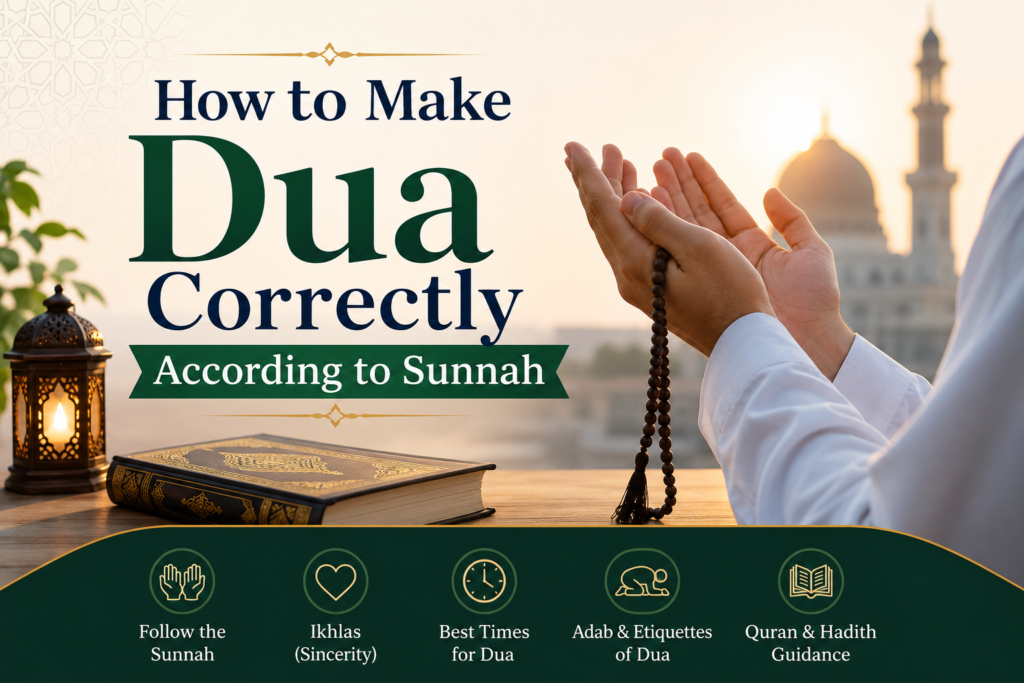
🤲 What Is Dua?
The Arabic word dua (الدعاء) means to call upon, to invoke, or to ask.
In Islam, dua is an act of worship in which a believer turns to Allah with hope, humility, gratitude, and complete reliance.
It is much more than simply asking for our needs.
Dua is a sign that we recognize Allah as the One who controls everything and that we depend on Him alone.
The Prophet Muhammad ﷺ said:
“Dua is worship.”
(Sunan Abi Dawud, Jami’ at-Tirmidhi – authenticated by scholars)
This hadith reminds us that every sincere supplication is itself an act of worship, whether we are asking for forgiveness, guidance, health, or thanking Allah for His countless blessings.
⭐ Why Is Dua So Important?
Many Muslims think of dua only when they are facing difficulties.
However, the Sunnah teaches us to make dua in times of ease as well as times of hardship.
The Prophet ﷺ said:
“Whoever wishes that Allah responds to him during hardship and difficulty, let him make plenty of dua during times of ease.”
(Jami’ at-Tirmidhi – Hasan according to many scholars)
Dua strengthens our relationship with Allah.
It reminds us that no matter how difficult life becomes, Allah is always near.
Allah says:
“And when My servants ask you concerning Me, indeed I am near. I respond to the call of the supplicant when he calls upon Me.”
(Surah Al-Baqarah 2:186)
This verse fills every believer with hope. Allah is not distant from those who sincerely turn to Him.
🕌 How to Make Dua Correctly According to Sunnah
Although dua can be made at any time and in any language, the Prophet ﷺ taught beautiful etiquettes that help us approach Allah with humility and sincerity.
Here is a step-by-step guide based on authentic Islamic teachings.
✅ Step 1: Begin by Praising Allah
How to Make Dua Correctly: Before asking Allah for your needs, begin by praising and glorifying Him.
You may praise Him by mentioning His beautiful names and attributes, such as:
- Al-Rahman (The Most Merciful)
- Al-Raheem (The Especially Merciful)
- Al-Ghafoor (The Most Forgiving)
- Al-Kareem (The Most Generous)
Starting with praise reminds us of Allah’s greatness and increases our humility before Him.
✅ Step 2: Send Salawat Upon Prophet Muhammad ﷺ
After praising Allah, send blessings upon Prophet Muhammad ﷺ.
For example:
Allahumma salli ‘ala Muhammad wa ‘ala aali Muhammad.
Many scholars mention that beginning and ending a dua with salawat is from the beautiful etiquettes taught in the Sunnah.
It also reminds us to remain connected to the Messenger ﷺ, whose guidance teaches us how to worship Allah correctly.
✅ Step 3: Raise Your Hands (When Appropriate)
How to Make Dua Correctly: The Prophet ﷺ often raised his hands while making dua.
Umar ibn Al-Khattab (RA) narrated that the Prophet ﷺ would raise his hands during certain supplications.
However, authentic Sunnah also shows that there were occasions where he made dua without raising his hands.
This teaches us that raising the hands is a recommended Sunnah in many situations, but it is not a condition for the acceptance of dua.
✅ Step 4: Face the Qiblah (If Possible)
How to Make Dua Correctly: Although it is not obligatory, facing the Qiblah while making dua is from the beautiful practices of the Prophet ﷺ on many occasions.
One example is during the prayer for rain (Salat al-Istisqa’), where the Prophet ﷺ faced the Qiblah while supplicating to Allah. (Sahih al-Bukhari & Sahih Muslim)
If you are unable to face the Qiblah, your dua is still valid because Allah hears His servants wherever they are.
The purpose is to approach Allah with respect and humility, not to make worship difficult.
✅ Step 5: Raise Your Hands with Humility: How to Make Dua Correctly
After praising Allah and sending blessings upon the Prophet ﷺ, raise your hands with sincerity and humility.
The Prophet ﷺ said:
“Indeed, your Lord is Modest and Most Generous. He is shy that when His servant raises his hands to Him, He returns them empty.”
(Sunan Abi Dawud, authenticated by scholars)
When making dua:
🤲 Raise both hands naturally.
🤲 Don’t rush.
🤲 Speak with humility.
🤲 Remember that you are speaking directly to your Creator.
✅ Step 6: Ask Allah with Complete Certainty
How to Make Dua Correctly: One of the greatest etiquettes of dua is having complete trust that Allah hears you.
The Prophet ﷺ said:
“Call upon Allah while being certain of being answered, and know that Allah does not answer a supplication from a heedless and distracted heart.”
(Jami’ at-Tirmidhi – graded Hasan by many scholars)
This doesn’t mean believing Allah must give exactly what we ask.
Rather, it means believing:
✔ Allah hears me.
✔ Allah loves when I ask Him.
✔ Allah will answer in the best way and at the best time.
✅ Step 7: Ask Allah with Sincerity (Ikhlas)
How to Make Dua Correctly: Dua should be made only to Allah.
Allah says:
“And the mosques are for Allah, so do not invoke anyone along with Allah.”
(Surah Al-Jinn 72:18)
Every Muslim should remember:
- We ask Allah alone.
- We place our trust in Allah alone.
- We hope only in Allah’s mercy.
Sincerity is one of the greatest reasons why dua is accepted.
✅ Step 8: Ask with Humility and Hope
Allah says:
“Call upon your Lord humbly and privately. Indeed, He does not like the transgressors.”
(Surah Al-A’raf 7:55)
When making dua:
❤️ Admit your weakness.
❤️ Recognize Allah’s greatness.
❤️ Hope in His mercy.
❤️ Fear His displeasure.
A heart that combines hope and humility is beloved to Allah.
✅ Step 9: Repeat Your Dua
The Sunnah teaches us that the Prophet ﷺ sometimes repeated important supplications three times.
Abdullah ibn Mas’ud (RA) narrated that when the Prophet ﷺ made dua, he often repeated it three times.
(Sahih Muslim)
Repeating your dua shows sincerity, persistence, and hope.
It is not necessary to repeat every dua three times, but it is a beautiful Sunnah on many occasions.
✅ Step 10: Ask for Both This World and the Hereafter
Sometimes we only ask Allah for worldly matters:
- A better job.
- Marriage.
- Wealth.
- Health.
Islam teaches us to ask for success in both worlds.
One of the greatest Quranic duas is:
“Our Lord, grant us good in this world and good in the Hereafter and protect us from the punishment of the Fire.”
(Surah Al-Baqarah 2:201)
This short dua covers every aspect of a believer’s life.
🌙 The Best Times to Make Dua: How to Make Dua Correctly
Although Allah accepts dua at any time, authentic Sunnah mentions certain occasions when supplication is especially encouraged.
🤲 During Sujood
The Prophet ﷺ said:
“The closest a servant comes to his Lord is while he is in prostration, so increase your supplication.”
(Sahih Muslim)
🌙 The Last Third of the Night
The Prophet ﷺ said:
“Our Lord descends every night to the lowest heaven during the last third of the night and says: ‘Who is calling upon Me so that I may answer him?'”
(Sahih al-Bukhari & Sahih Muslim)
This is one of the greatest times for dua.
🕌 Between the Adhan and Iqamah
The Prophet ﷺ said:
“The supplication made between the Adhan and the Iqamah is not rejected.”
(Sunan Abi Dawud, Jami’ at-Tirmidhi – authenticated by scholars)
🌿 While Fasting
The Prophet ﷺ informed us that the fasting person’s supplication is among those that are answered.
(Jami’ at-Tirmidhi and other collections; authenticated by scholars.)
🌅 On Friday
Authentic hadith mention that there is a special hour on Friday during which Allah answers the supplication of His servants.
Many scholars encourage increasing dua throughout Friday, especially toward the latter part of the day.
📌 Quick Checklist Before Making Dua
✅ Praise Allah.
✅ Send Salawat upon Prophet Muhammad ﷺ.
✅ Raise your hands (where appropriate).
✅ Face the Qiblah if possible.
✅ Ask with sincerity.
✅ Be certain Allah hears you.
✅ Ask for good in this life and the Hereafter.
✅ End with Salawat.
❌ 15 Common Mistakes Muslims Make While Making Dua: How to Make Dua Correctly
Even though Allah is The Most Merciful, Islam teaches us beautiful manners (adab) when making dua. Avoiding these common mistakes can help us strengthen our relationship with Allah.
❌ 1. Being Impatient
Many people make dua for a few days or weeks and then say:
“I’ve been making dua for so long, but Allah hasn’t answered me.”
The Prophet ﷺ said:
“The supplication of one of you will be answered so long as he is not impatient and says: ‘I made dua but I was not answered.'”
(Sahih al-Bukhari & Sahih Muslim)
Never lose hope in Allah’s wisdom.
❌ 2. Asking for Something Sinful
How to Make Dua Correctly: A Muslim should never ask Allah for something that involves sin or injustice.
For example:
- Helping someone commit a sin.
- Harming an innocent person.
- Breaking family ties.
The Prophet ﷺ said that a person’s dua continues to be answered as long as it does not involve sin or severing family ties. (Sahih Muslim)
❌ 3. Depending Only on Dua Without Taking Action
Dua is not a replacement for effort.
If you’re making dua:
- for success → study sincerely.
- for halal rizq → work honestly.
- for good health → take permissible means.
Islam teaches Tawakkul—trusting Allah while taking the lawful means available.
❌ 4. Neglecting Obligatory Worship
Some people ask Allah for blessings while neglecting Salah and other obligations.
Dua is strengthened when a believer strives to obey Allah in every aspect of life.
❌ 5. Consuming Haram Earnings
The Prophet ﷺ described a man who traveled, raised his hands in dua, but whose food, drink, clothing, and nourishment were from unlawful sources.
Then he said:
“So how can his supplication be answered?”
(Sahih Muslim)
This reminds us of the importance of earning halal and avoiding what Allah has prohibited.
❌ 6. Forgetting to Repent
How to Make Dua Correctly: Every human being sins.
Before asking Allah for our needs, we should frequently seek His forgiveness.
Allah loves those who sincerely repent.
❌ 7. Making Dua Only During Difficult Times
Allah loves those who remember Him during ease as well as hardship.
A strong relationship with Allah is built through consistency.
❌ 8. Having a Distracted Heart
How to Make Dua Correctly: The Prophet ﷺ said:
“Call upon Allah while being certain of being answered, and know that Allah does not answer a supplication from a heedless and distracted heart.”
(Jami’ at-Tirmidhi – Hasan)
When making dua, put away distractions and focus your heart on Allah.
❌ 9. Giving Up Too Soon
Some duas are answered quickly.
Others require patience.
Remember the stories of the Prophets:
- Zakariya (AS)
- Yaqub (AS)
- Ayyub (AS)
They remained patient and trusted Allah’s wisdom.
❌ 10. Thinking Allah Doesn’t Hear You
How to Make Dua Correctly: Allah says:
“Indeed, I am near. I respond to the call of the supplicant when he calls upon Me.”
(Surah Al-Baqarah 2:186)
Never think Allah has forgotten you.
❌ 11. Asking Without Humility
Dua should be made with humility, sincerity, and hope—not arrogance.
❌ 12. Forgetting to Praise Allah
The Sunnah teaches us to begin by praising Allah before presenting our requests.
❌ 13. Forgetting Salawat Upon the Prophet ﷺ
Sending blessings upon Prophet Muhammad ﷺ is one of the beautiful etiquettes of dua.
❌ 14. Limiting Allah’s Mercy
Never think:
- “My sins are too many.”
- “Allah will never forgive me.”
Allah’s mercy is greater than every sin for the one who sincerely repents.
❌ 15. Stopping Dua Altogether: How to Make Dua Correctly
Perhaps the greatest mistake is to stop making dua.
The believer never closes the door of hope.
As long as you are alive, keep asking Allah.
🌿 Powerful Duas from the Quran: How to Make Dua Correctly
These beautiful supplications are among the best duas because Allah Himself taught them in the Quran.
🤲 For Good in This Life and the Hereafter
رَبَّنَا آتِنَا فِي الدُّنْيَا حَسَنَةً وَفِي الْآخِرَةِ حَسَنَةً وَقِنَا عَذَابَ النَّارِ
Rabbana atina fid-dunya hasanatan wa fil-akhirati hasanatan wa qina ‘adhaban-nar.
Meaning:
“Our Lord, grant us good in this world and good in the Hereafter and protect us from the punishment of the Fire.”
(Surah Al-Baqarah 2:201)
🤲 For Knowledge: How to Make Dua Correctly
رَبِّ زِدْنِي عِلْمًا
Rabbi zidni ‘ilma.
Meaning:
“My Lord, increase me in knowledge.”
(Surah Taha 20:114)
🤲 For Forgiveness
رَبِّ اغْفِرْ لِي وَلِوَالِدَيَّ
Rabbighfir li wa liwalidayya.
Meaning:
“My Lord, forgive me and my parents.”
(Based on Quranic supplications, including Surah Ibrahim 14:41.)
🤲 For Steadfastness: How to Make Dua Correctly
رَبَّنَا لَا تُزِغْ قُلُوبَنَا بَعْدَ إِذْ هَدَيْتَنَا
Rabbana la tuzigh qulubana ba’da idh hadaytana.
Meaning:
“Our Lord, do not let our hearts deviate after You have guided us.”
(Surah Aal ‘Imran 3:8)
❤️ Does Allah Always Answer Dua?
Yes.
But Allah answers according to His perfect wisdom.
The Prophet ﷺ taught that when a believer makes a lawful dua, Allah responds in one of three ways:
✅ He grants what was requested.
✅ He removes an equivalent harm.
✅ He saves the reward for the Hereafter.
This means that no sincere dua is ever wasted.
📌 Key Takeaways: How to Make Dua Correctly
✔ Dua is one of the greatest acts of worship.
✔ Allah loves when His servants call upon Him.
✔ Begin your dua by praising Allah.
✔ Send blessings upon Prophet Muhammad ﷺ.
✔ Ask with sincerity and certainty.
✔ Continue making dua with patience.
✔ Avoid haram earnings and sinful requests.
✔ Never lose hope in Allah’s mercy.
❓ Frequently Asked Questions
Can I make dua in English?
Yes. You may ask Allah in any language you understand. Allah knows every language and understands what is in every heart. Many scholars encourage learning the beautiful supplications taught in the Quran and Sunnah, but making dua in your own language is permissible.
Should I raise my hands every time I make dua?
The Prophet ﷺ raised his hands in many situations, but not in every circumstance. Therefore, raising the hands is a Sunnah in many instances, not an absolute requirement.
Can I make dua after every Salah?
Yes. You may make dua after the prescribed adhkar following Salah. There are also authentic supplications during the prayer itself, especially in sujood and before the taslim.
Is there a best time for dua?
Yes. Some of the most virtuous times include:
- The last third of the night.
- During sujood.
- Between the adhan and iqamah.
- While fasting.
- During the special hour on Friday.
Can I ask Allah for worldly things?
Absolutely. Islam encourages believers to ask Allah for both their worldly needs and success in the Hereafter, as taught in the Quran.
🌸 Final Reflection
Dua is not just about asking Allah for what we want.
It is about building a relationship with our Creator.
Sometimes Allah answers immediately.
Sometimes He asks us to be patient.
Sometimes He gives us something even better than what we requested.
And sometimes He saves the reward until the Day when we will need it the most.
Every sincere dua you make is heard.
Every tear is seen.
Every whisper reaches Allah.
Never let Shaytan convince you that Allah is not listening.
Raise your hands with hope.
Call upon Him with sincerity.
Trust His wisdom even when you don’t understand His plan.
Because no one who sincerely places their trust in Allah is ever truly disappointed.
“And when My servants ask you concerning Me, indeed I am near. I respond to the call of the supplicant when he calls upon Me.”
📖 Surah Al-Baqarah (2:186)
May Allah accept all our duas, forgive our sins, keep our hearts firm upon Islam, and grant us goodness in this world and the Hereafter.
Ameen.