Introduction
Ghibah in Islam: Have you ever talked about someone and then said, “But I’m only telling the truth”?
That sentence may seem harmless, but in Islam, truthfulness does not automatically make talking about someone permissible.
The Prophet Muhammad ﷺ gave a clear definition of ghibah (backbiting): speaking about another person in a way that they would dislike. If what you say is true, it is ghibah. If it is false, it becomes a slanderous lie. This distinction is explicitly mentioned in Sahih Muslim 2589.
The Quran gives an even stronger warning. Allah compares backbiting to something deeply disturbing: eating the flesh of one’s dead brother.
So what exactly counts as backbiting? Is every discussion about another person ghibah? What about WhatsApp groups, family conversations, workplace complaints, or warning someone about another person’s behavior?
Let’s understand what the Quran and authentic Sunnah actually teach.
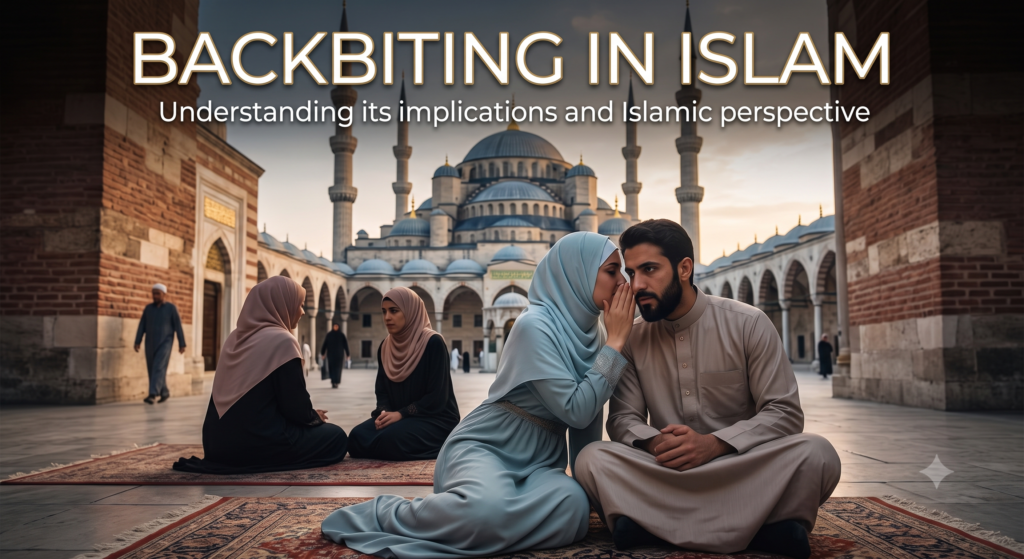
What Is Backbiting (Ghibah) in Islam?
Ghibah in Islam means speaking about another person in their absence in a way that they would dislike.
The Prophet Muhammad ﷺ asked the Companions:
“Do you know what is backbiting?”
They replied that Allah and His Messenger knew best.
He ﷺ explained that backbiting is mentioning your brother in a way that he dislikes.
The Companions then asked what would happen if the statement were actually true.
The Prophet ﷺ explained that if the statement is true, it is backbiting; if it is untrue, it is slander.
This hadith is recorded in Sahih Muslim 2589.
This gives us an important principle:
“But it’s true” is not a valid excuse for backbiting.
If the person would dislike you mentioning that particular fault about them, saying it behind their back can still be ghibah.
Is Ghibah in Islam Haram ?
Yes. Backbiting is prohibited in Islam.
Allah says in Surah Al-Hujurat:
“And do not spy, nor backbite one another.”
Allah then gives an extremely powerful comparison, asking whether anyone would like to eat the flesh of their dead brother.
The imagery is intentionally disturbing.
Why?
Because something that sounds small to the tongue can actually be a serious matter before Allah.
A person may spend only thirty seconds talking about someone.
But those thirty seconds can damage someone’s reputation, create resentment, break relationships and violate another person’s honor.
Islam therefore does not treat speech as something insignificant.
What Does the Quran Say About Backbiting?
Ghibah in Islam: The main Quranic warning about ghibah is found in Surah Al-Hujurat 49:12.
Allah mentions several behaviors together:
- Unnecessary suspicion
- Spying or searching for people’s private faults
- Backbiting
Then Allah gives the powerful comparison of eating the flesh of a dead brother.
This verse teaches us that Islamic social manners are not limited to avoiding physical harm.
A Muslim is also expected to protect the honor, privacy and dignity of others.
Interestingly, the verse ends by reminding believers that Allah is the Accepter of Repentance and Most Merciful.
So the warning is serious—but the door of repentance remains open.
What Are Examples of Ghibah in Islam?
Ghibah is not limited to saying:
“He is a bad person.”
It can take many forms.
For example:
- “He is so lazy.”
- “She is extremely difficult to deal with.”
- “His business isn’t doing well.”
- “You know how she behaves with people.”
- “He always makes mistakes.”
- “Her family is like that.”
- “I don’t like the way he talks.”
- “Look at what he is wearing.”
- “He thinks he knows everything.”
- “She is very stingy.”
Even if these statements are true, they can fall under ghibah when they are said about someone in a way they would dislike.
And it isn’t necessarily limited to words.
Ghibah in Islam can also involve gestures, facial expressions, written messages or other forms of communication when they convey something about a person that they would dislike being shared.
For example, someone asks:
“How is your colleague?”
You roll your eyes and laugh.
You may not have said a single word, but your gesture could communicate something negative about that person.
The principle is the same: don’t use communication to expose or mock someone’s faults.
“But I Was Telling the Truth!”
This is one of the most common misunderstandings about ghibah.
Someone might say:
“I didn’t lie about him. Everything I said was true.”
But the Prophet ﷺ specifically addressed this question.
He explained that if the fault is actually present in the person, mentioning it in the prohibited manner is ghibah.
If the fault isn’t present, then it becomes slander.
So there are two different problems:
If it is true:
It can be ghibah.
If it is false:
It becomes slander or false accusation, which is even more serious.
Therefore:
Truth does not make every statement about another person permissible.
What Is the Difference Between Ghibah and Slander?
The distinction is simple:
| Situation | What it can be |
|---|---|
| You mention a true fault someone dislikes behind their back | Ghibah (backbiting) |
| You say something false about someone | Slander / false accusation |
| You carry someone’s words between people to cause conflict | Namimah |
The Prophet ﷺ explicitly distinguished ghibah from false accusation in Sahih Muslim 2589.
Namimah is another serious problem.
The Prophet ﷺ strongly warned against it, and Sahih al-Bukhari records his warning regarding the qattat, understood in this context as one who carries tales between people.
These sins can overlap, but they are not identical.
Is Gossip the Same as Backbiting?
Not every use of the word gossip has a precise technical definition in Islamic law.
But much of what people casually call gossip can involve:
- Ghibah
- Slander
- Namimah
- Revealing someone’s private information
- Mocking or insulting someone
- Spreading rumors
This is why Muslims should be careful with conversations that begin with:
“Don’t tell anyone, but…”
or:
“You know what I heard about her?”
or:
“I’m not saying anything bad, but…”
Sometimes the introduction itself should make us pause.
Before continuing, ask:
“Would I say this if the person were sitting right here?”
That question can save the tongue from many mistakes.
Ghibah in Islam: Is Talking About Someone Always Ghibah?
No.
Islam does not prohibit every discussion about another person.
There are situations where mentioning someone’s conduct may be necessary for a legitimate reason.
For example, a person may need to:
- Seek help against genuine wrongdoing or injustice
- Ask a qualified scholar for a religious ruling
- Seek legitimate advice before making an important decision
- Warn someone from genuine harm
- Give necessary testimony
- Resolve a dispute or protect someone from harm
However, this should not become an excuse for gossip.
The key question is:
Is there a genuine legitimate need, or am I simply enjoying talking about this person’s faults?
If the real purpose is humiliation, entertainment, revenge or spreading someone’s faults, the excuse of “I’m just warning people” should not be used carelessly.
Scholars have discussed specific circumstances in which mentioning someone’s shortcomings can be permissible because of a genuine need. The principle is that the discussion should remain limited to what is actually necessary for that legitimate purpose.
What About Complaining About Someone?
This requires some distinction.
Suppose someone has genuinely wronged you.
You may need to speak to:
- A person who can help you
- A responsible authority
- A qualified scholar
- A mediator
- Someone whose advice is genuinely needed
That is different from telling ten unrelated people about the person’s faults simply because you are angry.
For example:
Necessary:
“My employer has withheld my salary for three months. I need advice about what I should do.”
Unnecessary gossip:
“Let me tell you what kind of terrible person my employer is…”
The first may involve a genuine need.
The second can easily become an opportunity for ghibah.
The safest approach is to say only what is necessary and avoid exaggeration, insults and unnecessary details.
Backbiting on WhatsApp and Social Media
Ghibah in Islam is not limited to face-to-face conversations.
Modern communication has simply given the tongue more places to operate.
Consider:
- WhatsApp groups
- Private messages
- Facebook comments
- Instagram DMs
- Telegram groups
- YouTube comments
- Voice notes
- Memes
- Screenshots
- Reaction emojis
- Sharing embarrassing information about someone
A person might think:
“I’m only sending it to my friends.”
But the moral question remains:
Would this person dislike that information being shared?
If yes, pause before forwarding it.
One screenshot can travel much further than the original conversation.
One joke can reach hundreds of people.
One rumor can permanently damage someone’s reputation.
So before forwarding a message, ask:
“Would I be comfortable if the person I am talking about saw this message?”
If the answer is no, don’t send it.
What If Someone Starts Backbiting in Front of Me?
This is where self-control becomes practical.
Imagine sitting with friends and someone says:
“You know what happened with Ahmed yesterday?”
You already know where the conversation may be heading.
You have several choices.
1. Change the subject
Say:
“Anyway, let’s talk about something else.”
A simple change of topic can stop a conversation from becoming sinful.
2. Don’t encourage the conversation
Avoid:
- Laughing
- Asking for more details
- Adding your own story
- Saying, “Really? What happened next?”
Your reactions can encourage the speaker to continue.
3. Defend the person’s honor when appropriate
If someone is being unfairly attacked, you can calmly say:
“Maybe we shouldn’t discuss him when he’s not here.”
You don’t need to start an argument.
Sometimes one respectful sentence is enough.
4. Leave the conversation if necessary
If the discussion continues and you cannot reasonably change it, distancing yourself can be better than sitting and enjoying the conversation.
Ghibah in Islam: Why Do People Backbite?
Understanding the reasons can help us stop.
People may fall into backbiting because of:
Anger
Someone hurt them, so they want others to know how bad that person is.
Jealousy
They feel uncomfortable with another person’s success.
Insecurity
Putting someone else down can temporarily make a person feel better about themselves.
Seeking attention
A dramatic story about another person can make the speaker the center of attention.
Friendship bonding
Sometimes people mistakenly think criticizing someone together creates closeness.
Revenge
They were embarrassed or insulted and want to retaliate.
Habit
The person has simply become accustomed to talking about others.
Entertainment
This may be one of the most dangerous reasons.
Someone says:
“We’re only joking.”
But another person’s dignity should not become entertainment.
How to Stop Backbiting
Stopping ghibah requires more than simply saying:
“I won’t do it again.”
You need to change the habits that lead to it.
Here are practical steps.
1. Pause Before You Speak
Before mentioning someone, ask yourself:
Is it true?
Is it necessary?
Would this person dislike me saying it?
Would I say it if they were standing here?
If you cannot justify the conversation, stop.
2. Stop Conversations Early
Don’t wait until the conversation becomes serious.
If someone begins discussing another person’s faults, change direction early.
A simple:
“Let’s not talk about him.”
can be enough.
3. Don’t Ask for Details
Sometimes we don’t start gossip.
We simply invite it.
Someone says:
“You won’t believe what she did…”
And we respond:
“What happened?”
That question may open the door.
Learn to recognize the setup.
4. Control Your Reactions
People often continue gossip because others laugh, react or show interest.
If you stop rewarding gossip with attention, conversations can change.
5. Avoid Fault-Finding
Surah Al-Hujurat 49:12 places backbiting alongside the prohibition of spying and searching for people’s faults.
Don’t make someone’s private life your investigation project.
You don’t need to know everything about everyone.
6. Remember Your Own Faults
Ghibah in Islam: One powerful way to become less interested in exposing others is to remember how many things Allah has concealed from people about us.
Instead of asking:
“What is wrong with him?”
ask:
“What do I need to improve in myself?”
This changes the direction of the heart.
7. Make Your Gatherings Better
If every conversation revolves around:
- People
- Drama
- Celebrities
- Neighbors
- Relatives
- Colleagues
- Family problems
then ghibah becomes easy.
Try replacing some of those conversations with:
- Beneficial knowledge
- Family matters
- Useful ideas
- Quran
- Personal goals
- Community needs
- Genuine advice
- Gratitude
Good conversations make it easier to protect the tongue.
What Should I Do If I Have Backbitten Someone?
Ghibah in Islam: If you realize that you have committed ghibah, don’t think:
“It’s too late now.”
It isn’t.
Allah says:
“Do not lose hope in the mercy of Allah.”
And He calls people back to repentance.
So take the mistake seriously, but don’t despair.
Step 1: Stop the backbiting
Don’t continue the conversation.
Step 2: Feel genuine regret
Recognize that you have crossed a boundary.
Step 3: Ask Allah for forgiveness
Make sincere tawbah and ask Allah to forgive you.
Step 4: Resolve not to return to it
Take practical steps to avoid the same situation.
Step 5: Repair harm where appropriate
If your words have caused actual harm, consider how you can correct the situation wisely.
There is a scholarly discussion about whether a person should always tell the victim of ghibah what was said. Telling someone about the backbiting can sometimes create additional hurt or conflict. Therefore, this should not be treated as a simplistic “always tell them” rule.
Instead, seek qualified scholarly advice when the situation involves serious harm or complicated circumstances.
What is clear is that sincere repentance should lead to changed behavior.
Ghibah in Islam: Can Allah Forgive Backbiting?
Yes, a person should never despair of Allah’s mercy.
Allah says:
“Do not lose hope in the mercy of Allah. Indeed, Allah forgives all sins.”
This does not mean that a Muslim should take sins lightly.
Rather, it means that when we fall, we should return to Allah instead of giving up.
For a sin involving another person’s rights, repentance should also involve taking the harm and the other person’s rights seriously.
The practical response is therefore:
Stop → regret → seek Allah’s forgiveness → avoid repeating it → address any harm wisely.
Ghibah in Islam: Does Listening to Backbiting Also Matter?
A person should not deliberately participate in a gathering where people are repeatedly attacking someone’s honor.
There is an important difference between:
- Accidentally hearing something
- Being unable to leave a situation
- Deliberately staying, encouraging and enjoying the conversation
If you can reasonably stop the conversation, change the topic, discourage it or leave, do so.
The Prophet ﷺ warned Muslims against backbiting and searching for people’s faults.
The goal isn’t merely to keep our own tongue clean.
It is also to avoid becoming an audience that encourages sinful speech.
Ghibah in Islam vs. Criticism: What Is the Difference?
Not every negative statement is automatically ghibah.
For example, if you are genuinely reviewing a product, evaluating a business, reporting misconduct or seeking legitimate advice, the purpose and circumstances matter.
But there is a major difference between constructive criticism for a legitimate purpose and attacking someone’s character for entertainment.
Ask:
Is my purpose to solve a problem?
or
Is my purpose to make this person look bad?
That question can expose our real intention.
Ghibah in Islam: Five Questions to Ask Before Talking About Someone
Before mentioning another person’s faults, ask yourself:
- Is what I’m saying true?
- Is it necessary?
- Is there a legitimate reason for saying it?
- Am I saying more than necessary?
- Would I be comfortable saying it if the person were standing here?
If the conversation fails these questions, silence may be safer.
A Simple Daily Challenge to Stop Ghibah in Islam
Try this for the next seven days.
Day 1
Notice how often conversations turn toward other people.
Day 2
Stop yourself from saying one unnecessary negative thing.
Day 3
Change the subject when someone starts gossiping.
Day 4
Don’t forward or share a negative story about someone.
Day 5
Say something good about someone instead of criticizing them.
Day 6
Spend a few minutes making dua for people you usually criticize.
Day 7
Review your week and identify the situations that most often trigger your tongue.
The goal is not perfection in seven days.
The goal is awareness, repentance and gradual change.
The Tongue Is Small, But Its Consequences Can Be Big
Ghibah in Islam: A conversation may last five minutes.
The person being discussed may never even know about it.
But Allah knows.
That is why the believer learns to think beyond:
“Did anyone hear me?”
and asks:
“Does Allah approve of what I am saying?”
Surah Al-Hujurat gives us a powerful picture of how seriously Islam takes a person’s honor. Allah prohibits backbiting and describes it through an image that makes us instinctively recoil.
The next time a conversation begins with someone’s name, pause.
You don’t have to know every detail.
You don’t have to share every opinion.
You don’t have to forward every message.
Sometimes the most beautiful thing you can say is nothing.
Ghibah in Islam: Final Takeaway
Ghibah in Islam: Backbiting (ghibah) in Islam means mentioning another person in a way they would dislike. If what you say is true, it can still be ghibah; if it is false, it becomes slander. This is the clear distinction given by the Prophet Muhammad ﷺ in Sahih Muslim.
Allah explicitly prohibits backbiting in the Quran and warns believers with the powerful analogy of eating the flesh of a dead brother.
So when you are about to talk about someone, pause and ask:
“Would I say this if they were sitting right beside me?”
And even more importantly:
“Would Allah be pleased with me saying it?”
Protecting someone’s honor may sometimes mean protecting your own Hereafter from a sin that began with nothing more than a few words.
May Allah purify our hearts, protect our tongues, forgive our mistakes and make us people who speak what is good and remain silent when silence is better. Ameen.
Ghibah in Islam: Frequently Asked Questions About Backbiting in Islam
1. What is ghibah in Islam?
Ghibah means mentioning another person in a way that they would dislike. The Prophet Muhammad ﷺ explained that if the statement is true, it is backbiting; if it is false, it becomes slander.
2. Is backbiting haram in Islam?
Yes. Allah explicitly commands believers not to backbite one another in Surah Al-Hujurat 49:12.
3. Is it still backbiting if what I say is true?
Yes. If you mention a true characteristic or fault that the person would dislike being mentioned, it can still be ghibah.
4. What if what I say about the person is false?
Then it is not merely ghibah; it becomes false accusation or slander. The Prophet ﷺ explicitly distinguished the two.
5. Is gossip the same as ghibah?
Gossip is a broad everyday term. It can include ghibah, slander, namimah or other harmful speech. The exact Islamic ruling depends on what is being said and why.
6. Is talking about someone’s mistakes always haram?
Not necessarily. There can be legitimate reasons to mention someone’s conduct, such as seeking justice, asking for qualified advice, obtaining a religious ruling or preventing genuine harm. The discussion should remain limited to what is necessary.
7. What should I do after backbiting someone?
Stop the behavior, sincerely repent to Allah, regret the sin, resolve not to repeat it and consider how to address any actual harm caused. If telling the person would create further harm, seek qualified advice about the appropriate way to handle the situation.
8. Can Allah forgive someone who backbites?
Yes. Muslims should never despair of Allah’s mercy. Allah says not to lose hope in His mercy and calls people to return to Him in repentance.
9. What should I do if my friends start backbiting?
Try to change the subject, discourage the conversation, avoid encouraging it through questions or laughter, or leave if necessary.
10. Does backbiting apply to WhatsApp and social media?
The medium does not change the underlying moral issue. If you communicate someone’s faults or private matters in a way they would dislike, the same principles of Islamic speech apply.
Ghibah in Islam: Featured Snippet Answer
What is backbiting in Islam?
Backbiting (ghibah) in Islam means mentioning another person in their absence in a way they would dislike. The Prophet Muhammad ﷺ explained that if what is said is true, it is backbiting; if it is false, it is slander. Allah explicitly prohibits backbiting in Surah Al-Hujurat 49:12.
Ghibah in Islam: Authenticity Note
The central evidence in this article comes from the Quran and authentic hadith, especially:
- Quran 49:11–12 — prohibition of mocking, insulting, suspicion, spying and backbiting.
- Sahih Muslim 2589 — definition of ghibah and distinction between ghibah and slander.
- Sahih al-Bukhari 6056 — warning concerning namimah/tale-bearing.
- Sunan Abi Dawud 4880 — warning against backbiting and searching for people’s faults; graded Hasan Sahih by Al-Albani on the cited source.
- Quran 39:53–54 — hope in Allah’s mercy and the command to return to Him in repentance.
Where scholars have differences concerning practical details—particularly how to handle informing someone who has been backbitten—the article avoids presenting one disputed approach as an unquestionable rule.