🌙 Introduction: Why Neighbors Matter in Islam
Who is a good neighbor?
Is it someone who greets you every morning, invites you for meals, or helps you when you need something? These are wonderful qualities. But Islam teaches us that being a good neighbor begins with something even more fundamental: ensuring that the people living around us are safe from our harm and treated with kindness.
A neighbor may be a close friend, a person from another religion, a family living next door, or someone you rarely speak to. Regardless of how close your relationship is, living near another person creates opportunities to practise patience, respect, generosity, and good character.
In Islam, the rights of neighbors are taken seriously. The Quran commands kindness toward both the near neighbor and the farther neighbor, while the Prophet Muhammad ﷺ repeatedly emphasized the importance of treating neighbors well.
Allah says in the Quran:
“…the near neighbor, the neighbor farther away…” (Quran 4:36)
Read Quran 4:36. The verse places kindness toward neighbors among other important responsibilities, including worshipping Allah, treating parents well, and helping those in need.
The Prophet Muhammad ﷺ also said:
“Gabriel continued to recommend me about treating the neighbors kindly…”
The narration explains that Jibreel (Gabriel) repeatedly advised the Prophet ﷺ about neighbors until he thought a neighbor might even be given a share of inheritance. Source: Sahih al-Bukhari 6015. Read the hadith.
This teaching shows just how important neighborly relations are in Islam.
In this guide, we will explore the rights of neighbors according to the Quran and authentic Sunnah, practical ways to fulfil these rights, common mistakes to avoid, and how to handle disagreements with neighbors in an Islamic manner.
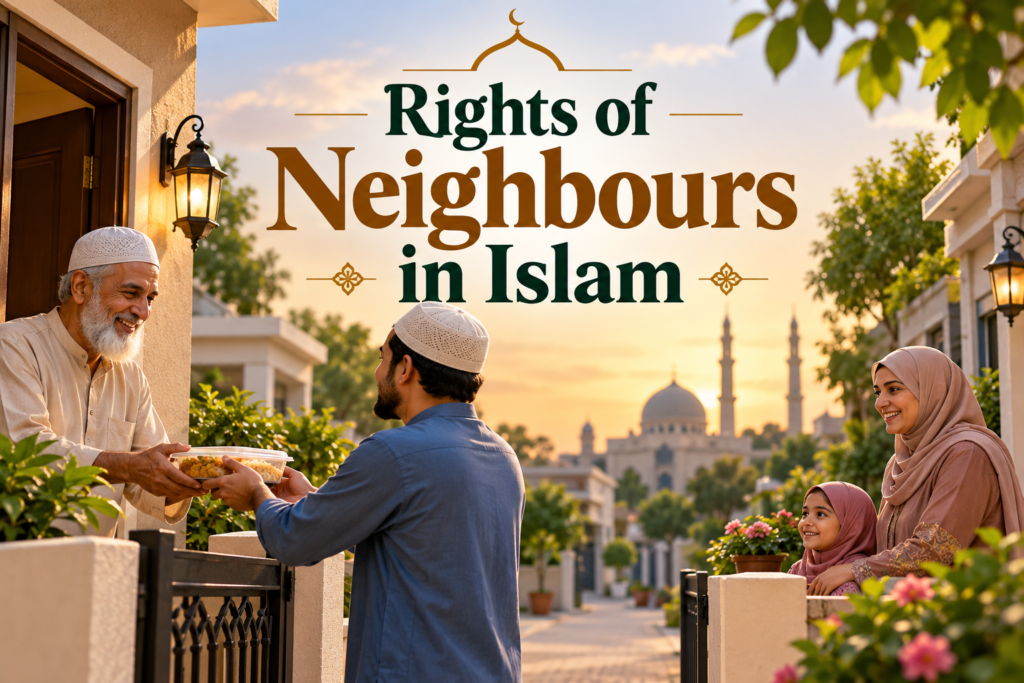
📖 What Are the Rights of Neighbors in Islam?
The rights of neighbors in Islam refer to the responsibilities Muslims have to treat nearby people with kindness, avoid causing them harm, respect their rights, and offer help when reasonably able.
These responsibilities include both avoiding harmful behavior and actively doing good.
For example, a Muslim should try to:
- 🤝 Treat neighbors respectfully, even when they have different beliefs or lifestyles.
- 🔇 Avoid causing unnecessary disturbance through loud noise or inconsiderate behavior.
- 🗣️ Refrain from insulting, mocking, spreading rumors about, or humiliating neighbors.
- ❤️ Offer help when a neighbor faces a genuine difficulty and assistance is reasonably possible.
- 🍲 Share food or gifts when appropriate and within one’s means.
- 🏠 Respect the privacy, property, and personal boundaries of neighboring households.
- ⚖️ Handle disagreements fairly rather than responding with revenge or hostility.
These examples are practical applications of the Quran’s guidance and the Prophet’s ﷺ teachings. Not every example is a separate, specifically worded legal ruling; individual circumstances and people’s rights also matter.
The central principle is simple: your neighbor should not have to fear your behavior, and your presence should bring consideration rather than unnecessary difficulty.
🕌 1. What Does the Quran Say About Neighbours?
Rights of Neighbors in Islam: The Quran provides an important foundation for understanding neighborly responsibilities.
📜 Quran 4:36 — Be Kind to the Near and Farther Neighbor
Allah commands believers to worship Him alone and show kindness to several groups, including parents, relatives, orphans, people in need, and neighbors.
The verse mentions both the near neighbor and the neighbor farther away. Scholars have discussed the precise meanings of these descriptions, but the general guidance clearly emphasizes kindness toward neighbors.
Practical lesson: Do not restrict good manners to close friends or people who share your background. Treat the people around you with fairness and consideration.
🗣️ Quran 49:11–12 — Avoid Insults, Mockery, and Backbiting
Allah forbids believers from ridiculing others, insulting one another, using offensive nicknames, spying, and backbiting.
These teachings are highly relevant to neighborhood life. Arguments about parking, noise, shared spaces, or property boundaries can easily turn into personal insults and gossip.
Islam encourages Muslims to address genuine problems without attacking people’s dignity or spreading unnecessary allegations.
🌿 Quran 16:90 — Uphold Justice and Good Conduct
Quran 16:90 commands justice and excellence in conduct and prohibits wrongdoing and transgression.
Practical lesson: If a dispute arises with a neighbor, do not assume that being a Muslim automatically makes your side correct. Listen, consider the facts, respect the other person’s rights, and seek a fair resolution.
🌟 2. What Did the Prophet Muhammad ﷺ Teach About Neighbors?
The authentic Sunnah reinforces the importance of treating neighbors well.
❤️ Hadith 1: Jibreel Repeatedly Emphasized Neighborly Kindness
The Prophet ﷺ reported that Jibreel continued advising him to treat neighbors kindly until he thought the neighbor might be given an inheritance share.
Reference: Sahih al-Bukhari 6015; Sahih Muslim 2625a.
Read Sahih al-Bukhari 6015 | Read Sahih Muslim 2625a.
This illustrates the seriousness with which the Prophet ﷺ regarded the rights of neighbors.
🛡️ Hadith 2: A Neighbor Must Be Safe From Your Harm
The Prophet ﷺ said:
“That person whose neighbor does not feel safe from his evil.”
This statement occurs in a narration in which the Prophet ﷺ strongly warns against such conduct.
Reference: Sahih al-Bukhari 6016.
The warning is a powerful reminder that avoiding harm is an essential part of good neighborly conduct.
Harm may take different forms: threats, harassment, damaging property, violating boundaries, or repeatedly creating unreasonable disturbances.
🤝 Hadith 3: Honor Your Neighbor
The Prophet ﷺ taught that whoever believes in Allah and the Last Day should treat their neighbor well, honor their guest, and speak good or remain silent.
Reference: Sahih Muslim 47a–48.
This connects neighborly behavior with faith and everyday manners. Respectful speech and consideration are not merely social courtesies; they are qualities Muslims are encouraged to cultivate.
🏡 3. Ten Important Rights of Neighbors in Islam
The following points translate the Quranic principles and authentic teachings into everyday actions.
1. 🛡️ The Right Not to Be Harmed
One of the clearest responsibilities is to avoid harming your neighbor.
Do not threaten, harass, deliberately intimidate, damage their property, or repeatedly disturb them without consideration.
For example, if your neighbor has young children, elderly family members, or someone who is unwell, be mindful of unnecessary noise, especially at inappropriate hours.
This does not mean that ordinary household sounds or reasonable daily activities are automatically wrongdoing. The point is to avoid unreasonable and preventable harm.
2. 🗣️ The Right to Respectful Speech
A neighbor’s mistake does not give you permission to insult them.
If a disagreement occurs, explain the problem calmly and focus on the actual issue instead of attacking the person’s character.
Instead of saying, “You are always a terrible neighbor,” you could say, “The noise has been making it difficult for us to sleep. Could we agree on a quieter time?”
Respectful communication can prevent a small problem from turning into a long-standing conflict.
3. 🏠 The Right to Privacy
Respect your neighbor’s home and personal boundaries.
Avoid peering into their private spaces, spreading information about their family, taking or sharing private photographs without permission, or entering their property without authorization.
The Quran also teaches believers to seek permission before entering homes in Quran 24:27. Read Quran 24:27.
Respecting privacy is a practical expression of dignity and good manners.
4. 🤲 The Right to Kindness and Assistance
A neighbor may face illness, an emergency, financial difficulty, or another unexpected problem.
When appropriate and reasonably possible, offer help. This could mean assisting with a practical task, checking whether they need urgent support, or helping them find someone who can assist.
Helping does not require you to endanger yourself, neglect your dependants, or provide money you cannot afford.
The important thing is to avoid indifference when a genuine need is within your ability to address.
5. 🍲 The Value of Sharing Food and Gifts
Sharing food can strengthen relationships and create goodwill.
A small portion of a meal, homemade food, or a thoughtful gift can help build a friendly environment.
The Prophet ﷺ advised Abu Dharr to add water to his broth and consider the people of nearby households when distributing it. This narration is recorded in Sahih Muslim 2625. Read the narration.
Do not turn this teaching into a financial burden. A gift does not have to be expensive, and a person’s inability to share food does not mean they have failed as a neighbor.
Kindness should be offered sincerely, without expecting repayment or praise.
6. ⚖️ The Right to Fair Treatment
Do not take advantage of your neighbor.
Respect property boundaries, shared spaces, agreements, and legitimate rights. Do not use a person’s absence to encroach on their property or assume that you may use their belongings without permission.
If a disagreement concerns parking, construction, water, noise, or common areas, seek a solution that considers the facts and the rights of everyone involved.
7. 🤐 The Right to Be Protected From Gossip
Neighborhoods often bring people into contact with one another, which can create opportunities for gossip.
Avoid spreading rumors about a neighbor’s marriage, finances, children, personal difficulties, or private life.
Quran 49:12 prohibits backbiting and spying. Read the verse.
If you have a legitimate concern about harm or wrongdoing, seek appropriate advice or report it to the relevant person or authority rather than spreading allegations socially.
8. 🌸 The Right to Good Manners Regardless of Religion
The Quran’s command in 4:36 includes the near and farther neighbor without restricting the instruction in the verse to neighbors who share the same faith.
Muslims should not use religious differences as an excuse for injustice, hostility, or mistreatment.
You can maintain your own religious commitments while treating a neighbor from another faith with fairness, courtesy, and consideration.
9. 🫶 The Right to Consideration During Difficult Times
A neighbor may be grieving, unwell, caring for a newborn, preparing for an important examination, or dealing with a family emergency.
Being thoughtful about avoidable noise, offering condolences when appropriate, or providing practical help can make a real difference.
Do not assume that a neighbor wants visitors or assistance in every circumstance. Consider their preferences and respect their boundaries.
10. 🤝 The Right to a Peaceful Resolution of Disputes
Disagreements happen. Islam does not require people to pretend that every relationship is perfect.
However, a disagreement should not become an excuse for threats, revenge, humiliation, or deliberate harm.
Start with calm communication when it is safe and appropriate. If the problem continues, consider a trusted mediator, housing association, landlord, or relevant authority, depending on the issue.
Seeking a fair resolution is compatible with good character.
🌍 4. Do Muslims Have to Treat Non-Muslim Neighbors Kindly?
Yes. Religious difference is not a justification for mistreating a neighbor.
Quran 4:36 commands kindness toward neighbors, including the near and farther neighbor. The general wording establishes a strong basis for considerate conduct beyond one’s immediate circle.
Muslims can maintain their beliefs and religious boundaries while still being fair, helpful, and respectful toward people of other faiths.
For example, a Muslim can assist a non-Muslim neighbor during an emergency, speak honestly during a property dispute, or offer a courteous greeting appropriate to the situation.
Good treatment does not require compromising one’s beliefs. It requires observing justice and good conduct.
🕌 5. Who Counts as a Neighbor in Islam?
The Quran refers to the near neighbor and the farther neighbor in Quran 4:36, but it does not specify a universal number of houses that defines a neighbor.
Muslim scholars have discussed the scope of the term neighbor in different ways, including physical proximity and other contextual considerations.
For practical purposes, do not use uncertainty about an exact boundary as an excuse to mistreat people living nearby.
Someone living next door, across the street, in the same apartment building, or in the immediate neighborhood may have legitimate reasons to expect consideration regarding noise, safety, shared spaces, and respectful conduct.
A note on popular claims: You may encounter statements that Islam defines a neighbor as exactly 40 houses in every direction. Avoid presenting that number as a definitively established rule from an authentic hadith without reliable evidence and appropriate scholarly qualification.
The established Quranic and authentic hadith teachings are sufficient to show that neighborly kindness deserves serious attention.
⚠️ 6. Common Mistakes Muslims Should Avoid With Neighbors
Even when people know that Islam values neighborly rights, everyday habits can cause unnecessary difficulties.
🚫 Ignoring Disturbing Noise
Playing loud music, shouting late at night, or repeatedly disturbing nearby households without consideration can damage relationships.
Be mindful of the effects of your actions and take reasonable steps to reduce avoidable disturbance.
🚫 Treating Small Disagreements as Personal Battles
A disagreement over parking or shared space should not become a reason to insult an entire family.
Address the issue rather than attacking people’s dignity.
🚫 Spreading Rumors
Do not assume that something is true merely because several people in the neighborhood are discussing it.
Avoid spreading unverified allegations or private information.
🚫 Expecting Kindness Without Giving It
Some people expect neighbors to help them but show little consideration in return.
Islam encourages believers to be mindful of their own responsibilities rather than focusing only on what others owe them.
🚫 Using Religious Language to Humiliate Others
Religious advice should not become an excuse for personal attacks or public shaming.
When offering advice, consider whether it is truthful, necessary, respectful, and likely to help.
🚫 Confusing Kindness With Accepting Abuse
Being a good neighbor does not mean allowing another person to threaten you, exploit you, or repeatedly violate your rights.
You can remain respectful while setting boundaries and seeking lawful help when necessary.
🌱 7. How to Become a Better Neighbor: A Practical Checklist
You do not need to perform grand gestures to improve your relationship with your neighbors. Begin with everyday habits.
- Greet neighbors courteously when appropriate.
- Keep noise at a considerate level.
- Respect private property and personal boundaries.
- Avoid gossip, insults, and unnecessary arguments.
- Offer assistance when a genuine need arises and you can reasonably help.
- Share food or gifts when appropriate and within your means.
- Be fair in disagreements about parking, property, or shared spaces.
- Communicate problems calmly instead of allowing resentment to grow.
- Respect neighbors whose religion, culture, or lifestyle differs from yours.
- Reflect on whether your behavior makes the neighborhood more peaceful.
Choose one or two actions to practise this week. Consistent good manners can help build trust over time.
❓ Frequently Asked Questions About Neighbors’ Rights in Islam
📖 What are the rights of neighbors in Islam?
Islam emphasizes kindness toward neighbors, avoiding harm, respectful communication, fairness, and practical assistance where reasonably possible. Quran 4:36 commands kindness toward the near and farther neighbor, while authentic hadith repeatedly reinforce this responsibility.
🕌 What does the Quran say about neighbors?
Quran 4:36 commands kindness toward the near neighbor and the farther neighbor, alongside other important responsibilities. Quran 49:11–12 also prohibits insults, mockery, spying, and backbiting, which are relevant to maintaining peaceful relationships.
🌟 What did Prophet Muhammad ﷺ say about neighbors?
In Sahih al-Bukhari 6015, the Prophet ﷺ said that Jibreel repeatedly advised him to treat neighbors kindly. Sahih al-Bukhari 6016 also strongly warns against a person whose neighbor does not feel safe from their harm.
🤝 Should Muslims treat non-Muslim neighbors well?
Yes. Religious difference does not justify injustice or mistreatment. The Quran’s guidance on neighborly kindness provides a basis for respectful and fair treatment of neighbors beyond one’s own religious community.
🍲 Is sharing food with neighbors encouraged in Islam?
Yes. Sharing food is a practical expression of generosity and kindness. The Prophet ﷺ encouraged Abu Dharr to consider his neighbors when preparing broth, as recorded in Sahih Muslim 2625. Sharing should remain within one’s means.
⚖️ What should I do if my neighbor mistreats me?
When safe and appropriate, communicate the problem calmly and explain its practical effects. If the issue continues, consider mediation or the relevant lawful process. Good character does not require accepting abuse or surrendering legitimate rights.
🏠 Is there an exact number of houses that count as neighbors in Islam?
The Quran does not specify a universal number of houses defining a neighbor. Scholars have discussed the scope of the term in different ways. It is safer not to present the popular claim of exactly 40 houses in every direction as an established rule without reliable evidence.
❤️ Why are neighbors important in Islam?
Neighbors are part of our everyday social environment. Treating them well encourages safety, trust, mutual assistance, and peaceful coexistence. The repeated emphasis on neighborly kindness in authentic hadith demonstrates the importance of this responsibility.
🌿 Does Islam require helping every neighbor with every request?
No. Kindness and assistance should be balanced with your legitimate responsibilities, means, safety, and the nature of the request. You can refuse an unreasonable request respectfully while still treating the person fairly.
🔎 Featured Snippet: Rights of Neighbors in Islam
The rights of neighbors in Islam include treating them with kindness, avoiding harm, respecting privacy and property, speaking respectfully, and helping when reasonably able. Quran 4:36 commands kindness toward the near and farther neighbor, while Sahih al-Bukhari 6015 and 6016 emphasize good treatment of neighbors and warn against causing them harm.
🌙 Conclusion: Be the Neighbor Who Brings Peace
A good Muslim should strive to be someone whose presence brings safety, consideration, and kindness to the people nearby.
You do not have to be close friends with every neighbor. You may have different lifestyles, different beliefs, or occasional disagreements. But these differences should not become excuses for injustice, hostility, or unnecessary harm.
Respecting boundaries, speaking fairly, helping when you can, and avoiding gossip are practical ways to live by Islamic teachings.
The Prophet Muhammad ﷺ emphasized neighborly kindness so strongly that Jibreel’s repeated advice made him think a neighbor might even receive an inheritance share.
That teaching should make us pause and reflect on our own conduct.
Do our neighbors feel safe from our words and actions? Do we respect their rights even when we disagree? Do we make the place where we live more peaceful?
May Allah help us fulfil the rights of our neighbors, improve our character, and make us a source of goodness and peace for those around us. Ameen.
📚 Quran and Hadith References
- Quran 4:36 — Kindness toward the near and farther neighbor. Read the verse.
- Quran 49:11–12 — Prohibition of mockery, insults, spying, and backbiting. Read the verses.
- Quran 24:27 — Seeking permission before entering homes. Read the verse.
- Sahih al-Bukhari 6015 — Jibreel repeatedly advised the Prophet ﷺ to treat neighbors kindly. Read the hadith.
- Sahih Muslim 2625a — The same teaching about the importance of neighbors. Read the hadith.
- Sahih al-Bukhari 6016 — Strong warning against harming a neighbor. Read the hadith.
- Sahih Muslim 47a–48 — Treating neighbors well, honoring guests, and speaking good or remaining silent. Read the hadith.