🌙 Introduction: What Does Islam Teach About Anger?
How to Control Anger in Islam: Quran, Hadith & Tips: Have you ever said something hurtful during an argument and regretted it later? Have you ever shouted at your children, spoken harshly to your spouse, or reacted angrily to a colleague over something that could have been handled calmly?
Anger is a human emotion. Everyone experiences it at some point. However, when anger controls our words and actions, it can damage relationships, hurt people, and lead us to do things we later regret.
Islam teaches Muslims to develop self-control, patience, and good character. The goal is not simply to avoid feeling angry; it is to learn how to respond to anger in a way that pleases Allah.
The Prophet Muhammad ﷺ gave a powerful definition of real strength:
“The strong is not the one who overcomes the people by his strength, but the strong is the one who controls himself while in anger.”
Source: Sahih al-Bukhari 6114.
This hadith changes how we think about strength. Real strength is not shouting louder, winning every argument, or intimidating another person. It is having the ability to control yourself when your emotions are intense.
The Quran also praises those who restrain their anger and forgive others:
“…who restrain anger and pardon people—and Allah loves the good-doers.”
Quran 3:134.
In this article, we will explore what the Quran and authentic Sunnah teach about anger, how the Prophet Muhammad ﷺ guided Muslims to control it, practical steps to manage anger, and a dua to seek Allah’s help.
📖 What Is Anger in Islam?
Anger is an emotional response that can arise when a person feels hurt, frustrated, threatened, disrespected, or treated unfairly.
Islam does not teach that every experience of anger is automatically sinful. Rather, Muslims are encouraged to control their anger and avoid allowing it to lead to injustice, harmful speech, aggression, or other wrongdoing.
For example:
- Becoming angry when someone insults you is a human reaction.
- Insulting them back with abusive language is a choice.
- Feeling upset when someone treats you unfairly is understandable.
- Taking revenge beyond what is justified is wrongdoing.
- Feeling frustrated with your children is possible.
- Taking that frustration out on them through cruelty is harmful.
The important distinction is between feeling anger and acting upon anger in an unacceptable way.
A Muslim should try to develop patience, exercise self-control, and choose a response that reflects Islamic manners.
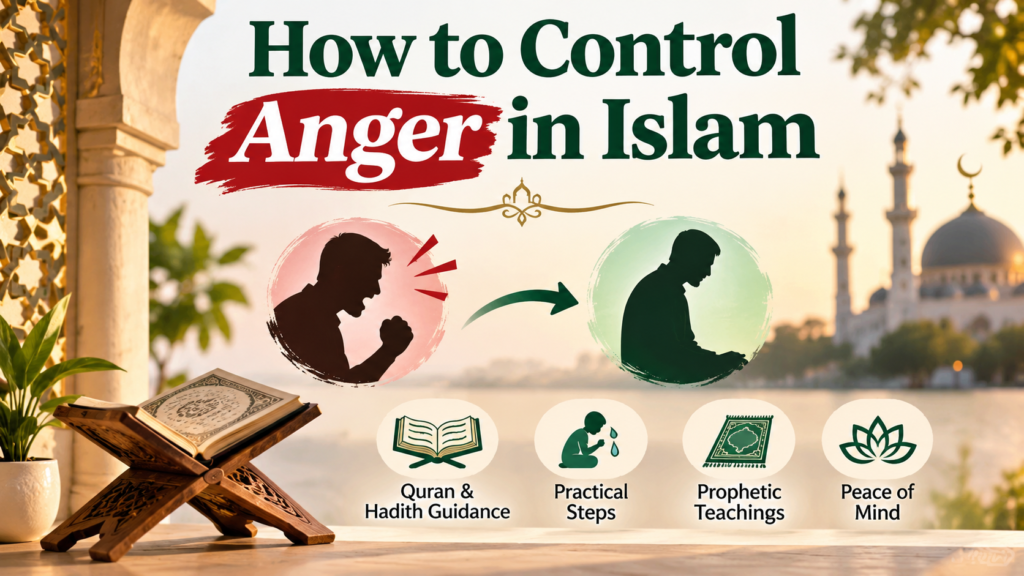
🕌 1. What Does the Quran Say About Controlling Anger?
The Quran provides clear guidance about restraining anger, seeking refuge in Allah, responding to wrongdoing, and forgiving others.
🌿 1. Quran 3:134 — Restrain Your Anger and Forgive Others
Allah describes the qualities of the righteous:
“…who restrain anger and pardon people—and Allah loves the good-doers.”
Reference: Quran 3:134
This verse teaches two important qualities:
1. Restraining anger: A believer should not allow anger to control their behavior or lead them to harm others.
2. Forgiving people: A believer should be willing to forgive when appropriate, rather than holding on to resentment and constantly seeking revenge.
Notice that Allah connects these qualities with Ihsan (excellence in doing good).
Controlling anger is therefore not merely a way to maintain peaceful relationships. It is also an important part of developing good character.
🤲 2. Quran 7:200 — Seek Refuge in Allah
Allah says:
“And if an evil suggestion comes to you from Satan, then seek refuge in Allah. Indeed, He is Hearing and Knowing.”
Reference: Quran 7:200
This verse gives believers guidance when they experience satanic suggestions or provocation.
When anger begins to take control, a Muslim should turn to Allah for protection rather than allowing harmful thoughts to guide their response.
This guidance is also reflected in an authentic hadith in which the Prophet ﷺ advised an angry man to seek refuge in Allah from Satan.
❤️ 3. Quran 41:34 — Respond to Evil With What Is Better
Allah says:
“And not equal are the good deed and the bad. Repel [evil] by that [deed] which is better; and thereupon the one whom between you and him is enmity will become as though he was a devoted friend.”
Reference: Quran 41:34
This verse teaches a beautiful principle: do not automatically respond to someone’s bad behavior with more bad behavior.
For example, imagine a colleague speaks rudely to you.
You have a choice:
- Respond with insults and make the disagreement worse.
- Remain composed and address the issue respectfully.
The second response may help prevent a temporary disagreement from becoming a lasting conflict.
However, responding with what is better does not mean accepting abuse or abandoning your legitimate rights. You can be respectful while setting boundaries.
⚖️ 4. Quran 42:40 — Forgiveness and Justice
Allah says:
“And the retribution for an evil act is an evil one like it, but whoever pardons and makes reconciliation—his reward is [due] from Allah.”
Reference: Quran 42:40
This verse provides an important balance.
Islam recognizes the right to seek justice and an appropriate response to wrongdoing. At the same time, forgiving someone and seeking reconciliation can bring a great reward from Allah.
Therefore, controlling anger does not mean allowing people to repeatedly violate your rights.
A Muslim should avoid oppression, but should also avoid becoming oppressive in response.
🌟 2. What Did Prophet Muhammad ﷺ Say About Anger?
The Prophet Muhammad ﷺ gave practical guidance about controlling anger. These teachings help Muslims understand that self-control is more valuable than reacting aggressively.
🛡️ Hadith 1: Do Not Become Angry
A man came to the Prophet ﷺ and asked him for advice.
The Prophet ﷺ replied:
“Do not become angry.”
The man repeated his request several times, and each time the Prophet ﷺ gave the same advice.
Source: Sahih al-Bukhari 6116.
This short advice carries a powerful message.
It encourages us not to surrender to anger or allow it to control our behavior. When frustration arises, we should make an effort to remain calm and avoid harmful reactions.
It should not be understood as saying that a person can never experience the emotion of anger. Rather, it is guidance to restrain anger and avoid its destructive consequences.
💪 Hadith 2: Real Strength Is Controlling Yourself
The Prophet ﷺ said:
“The strong is not the one who overcomes the people by his strength, but the strong is the one who controls himself while in anger.”
Source: Sahih al-Bukhari 6114.
Consider two people.
One becomes angry, shouts, threatens others, and tries to win every argument.
The other feels equally frustrated but controls their words, avoids hurting anyone, and addresses the problem calmly.
According to the teaching of this hadith, real strength is demonstrated through self-control.
🤲 Hadith 3: Seek Refuge in Allah From Satan
Sulaiman ibn Surad (RA) reported that two people were arguing in the presence of the Prophet ﷺ. One became extremely angry, and his face and neck showed signs of intense anger.
The Prophet ﷺ said that he knew a phrase which, if the angry person said it, would remove his anger.
That phrase was:
أَعُوذُ بِاللَّهِ مِنَ الشَّيْطَانِ الرَّجِيمِ
Transliteration: A’udhu billahi min ash-shaytan ir-rajim.
Meaning: I seek refuge in Allah from Satan, the accursed.
Source: Sahih Muslim 2610a.
This hadith provides a specific prophetic instruction for a moment of anger.
When you feel anger rising, pause and seek Allah’s protection instead of immediately reacting.
🧘 Hadith 4: Change Your Position When Angry
The Prophet ﷺ said:
“When one of you becomes angry while standing, he should sit down. If the anger leaves him, well and good; otherwise he should lie down.”
Source: Sunan Abi Dawud 4782.
This narration offers a practical action: change your physical position when anger arises.
The hadith has been graded Sahih by Shaykh al-Albani.
The lesson is simple: when you are angry, avoid continuing the confrontation in the same heated state. Take a moment to calm down before deciding what to say or do.
🌱 3. How to Control Anger According to Islam: 10 Practical Steps
The Quran and Sunnah provide guidance that we can apply in our everyday lives. Here are ten practical steps to help manage anger.
1. 🤲 Seek Refuge in Allah
As taught in Sahih Muslim 2610a, say:
A’udhu billahi min ash-shaytan ir-rajim.
Meaning: I seek refuge in Allah from Satan, the accursed.
Do not allow anger to immediately turn into harmful words or actions. Turn to Allah and seek His protection.
2. 🛑 Pause Before Speaking
Sometimes the most helpful response is to stop talking for a moment.
When you are angry, you may say things you do not truly mean. You may insult someone, reveal private information, or make promises and threats that you later regret.
Give yourself time before responding.
3. 🧘 Sit Down if You Are Standing
The Prophet ﷺ advised changing your position when angry.
If you are standing during an argument, sit down. If your anger continues, the narration advises lying down.
This is a practical way to interrupt an escalating confrontation.
4. 🚶 Step Away From the Situation Temporarily
When an argument becomes heated, consider taking a short break.
For example, you might say:
“I am upset right now. Let us discuss this when we are both calmer.”
This is a practical self-management suggestion, not a separately prescribed prophetic ritual.
The purpose is to prevent an emotional reaction from causing unnecessary harm.
5. 🗣️ Choose Your Words Carefully
Before speaking, ask yourself:
- Is what I am about to say true?
- Will these words solve the problem?
- Am I about to insult or humiliate someone?
- Will I regret saying this later?
Good character includes controlling the tongue, especially during disagreements.
6. ❤️ Remember the Virtue of Restraining Anger
Remember Quran 3:134, where Allah praises those who restrain their anger and pardon people.
When you feel angry, remind yourself that controlling your reaction is an opportunity to practise a quality Allah loves.
7. ⚖️ Focus on Solving the Problem, Not Winning the Argument
An argument should not become a competition to prove who is more powerful.
Try to understand the actual problem.
For example, if your spouse disagrees with you, listen to their point of view rather than interrupting or repeatedly bringing up previous mistakes.
The aim should be a fair solution, not simply winning.
8. 🌸 Forgive When Appropriate
Forgiveness can help repair relationships and prevent resentment from controlling your heart.
However, forgiveness does not mean that you must immediately trust someone again, ignore repeated wrongdoing, or remain in an unsafe situation.
You can forgive while maintaining healthy boundaries and seeking justice.
9. 🤝 Apologise When You Make a Mistake
If anger causes you to speak harshly or hurt someone, take responsibility.
A sincere apology is better than pretending nothing happened.
You can say:
“I was angry, but that does not justify the way I spoke to you. I am sorry.”
Recognising your mistake is an important step toward improving your character.
10. 📖 Build Patience Through Daily Practice
Do not wait for a major argument to start working on anger management.
Practise patience in small situations:
- When someone interrupts you.
- When traffic makes you late.
- When your children make mistakes.
- When a colleague disagrees with you.
- When someone does not respond to your message.
- When plans do not go as expected.
Small opportunities to practise self-control can help you respond more thoughtfully during difficult situations.
🏡 4. How to Control Anger With Family According to Islam
Our character is often tested most strongly at home.
It may be easy to remain polite with strangers, colleagues, or guests, but much harder to control frustration with people we see every day.
Islam encourages kindness, patience, and respect within family relationships.
💍 1. Controlling Anger With Your Husband or Wife
Disagreements between spouses are possible in any marriage.
However, anger should not become an excuse for insults, threats, humiliation, or bringing up sensitive personal matters.
Try to:
- Listen before responding.
- Avoid arguing when either person is extremely upset.
- Discuss one problem at a time.
- Avoid involving children in marital arguments.
- Apologise when you make a mistake.
- Seek a fair solution rather than trying to dominate the other person.
Remember that your spouse deserves respect even during disagreements.
🧒 2. Controlling Anger With Children
Children make mistakes while learning.
They may create a mess, refuse to listen, break something accidentally, or repeat behavior that frustrates their parents.
Instead of reacting with uncontrolled anger:
- Explain what went wrong.
- Correct the behavior calmly.
- Give age-appropriate guidance.
- Avoid humiliating or frightening the child.
- Recognise when you need a short break before responding.
Parents should remember that children learn from the way adults manage their emotions.
👨👩👧 3. Controlling Anger With Parents and Relatives
Family disagreements can sometimes involve old misunderstandings and emotional issues.
Try to avoid shouting, insulting, or unnecessarily exposing private family matters.
The Quran teaches kindness toward parents in Quran 17:23–24.
Respectful communication is particularly important when dealing with older family members, even when you disagree with them.
🏢 5. Controlling Anger at Work and in Everyday Life
Anger does not arise only at home. Workplace pressures, difficult colleagues, financial concerns, traffic, and daily responsibilities can also create frustration.
A Muslim should try to apply Islamic manners in professional and social life.
💼 At the Workplace
Imagine your manager criticises your work in front of others.
You may feel embarrassed or angry.
Instead of immediately responding with harsh words, take a moment and consider whether the criticism contains something useful. If it was inappropriate, address it respectfully through a suitable conversation.
🚗 While Driving
Traffic congestion, careless driving, or someone cutting in front of you can easily cause frustration.
Avoid road rage, threats, aggressive driving, or attempts at revenge.
Your safety and the safety of others are more important than winning a confrontation.
📱 On Social Media
Online arguments can quickly become personal.
Avoid insulting people, sending abusive messages, spreading private screenshots, or making accusations when you are angry.
Before replying to a controversial post, consider whether your response will provide any real benefit.
⚠️ 6. Common Mistakes Muslims Should Avoid When Angry
❌ 1. Thinking That Shouting Means Strength
Raising your voice or intimidating another person does not make you stronger.
The Prophet ﷺ taught that real strength lies in controlling oneself during anger.
❌ 2. Using Abusive Language
Insults, humiliation, and hurtful words can leave lasting emotional damage.
Once spoken, words cannot always be taken back.
❌ 3. Bringing Up Past Mistakes
During an argument, some people repeatedly mention old mistakes to hurt the other person.
This rarely solves the current problem and often creates further resentment.
❌ 4. Making Important Decisions While Extremely Angry
Avoid rushing into major decisions during an intense emotional moment.
Where possible, wait until you are calm enough to think clearly. For serious religious or legal matters, seek qualified guidance rather than relying on an angry reaction.
❌ 5. Confusing Forgiveness With Accepting Abuse
Islam encourages forgiveness, but it does not require a person to remain in an unsafe or abusive situation.
Protecting yourself and seeking appropriate help are compatible with good character.
❌ 6. Justifying Every Reaction by Saying “I Was Angry”
Anger may explain why you reacted emotionally, but it does not automatically justify harmful behavior.
Take responsibility and try to repair the harm you caused.
🤲 7. Dua to Seek Allah’s Protection During Anger
One authentic supplication taught by the Prophet Muhammad ﷺ for a situation involving intense anger is:
أَعُوذُ بِاللَّهِ مِنَ الشَّيْطَانِ الرَّجِيمِ
Transliteration: A’udhu billahi min ash-shaytan ir-rajim.
Meaning: I seek refuge in Allah from Satan, the accursed.
Source: Sahih Muslim 2610a.
🌿 When Should You Say This?
You can say this when you feel provoked and experience anger, seeking Allah’s protection from harmful satanic suggestions.
Remember that the purpose is not simply to repeat words mechanically. Seek Allah’s protection sincerely and make an effort to control your response.
❤️ Ask Allah for Help Beyond the Moment of Anger
You can also make personal dua asking Allah to grant you patience, self-control, forgiveness, and good character.
For example:
“O Allah, help me control my anger, protect me from harmful words and actions, make me patient, and guide me toward good character.”
This is a personal supplication, not a quoted prophetic dua.
🗓️ 8. A Simple 7-Day Anger Control Challenge
Use this seven-day challenge as a practical starting point.
🌱 Day 1: Identify Your Anger Triggers
Notice the situations that make you angry.
Is it criticism, traffic, financial stress, family disagreements, or something else?
🤲 Day 2: Practise Seeking Refuge in Allah
Learn the meaning of A’udhu billahi min ash-shaytan ir-rajim and remember to seek Allah’s protection when provoked.
🛑 Day 3: Pause Before Responding
Make a conscious effort not to reply immediately when you are angry.
🧘 Day 4: Practise Changing Your Position
Remember the guidance in Sunan Abi Dawud 4782 about sitting down when angry while standing.
❤️ Day 5: Avoid Hurtful Words
Pay particular attention to how you speak to your spouse, children, parents, and colleagues.
🤝 Day 6: Apologise or Resolve a Disagreement
If your anger has hurt someone, take responsibility and try to make things right.
🌸 Day 7: Review Your Progress
Ask yourself:
- Did I control my anger better this week?
- Did I avoid unnecessary arguments?
- Did I speak more respectfully?
- Did I seek Allah’s help when frustrated?
- What should I improve next week?
Remember, seven days will not magically eliminate anger. The challenge is simply a starting point for consistent improvement.
❓ Frequently Asked Questions About Anger in Islam
1. 😠 Is feeling angry haram in Islam?
Feeling anger is a human emotional response and is not automatically sinful. What matters is how a person handles it. Muslims should avoid allowing anger to lead to injustice, abuse, harmful speech, or other wrongdoing.
2. 📖 What does the Quran say about controlling anger?
Quran 3:134 praises those who restrain their anger and pardon people. Quran 41:34 also teaches believers to respond to evil with what is better.
3. 🕌 What did Prophet Muhammad ﷺ say about anger?
In Sahih al-Bukhari 6116, a man asked the Prophet ﷺ for advice, and he repeatedly replied, “Do not become angry.” In Sahih al-Bukhari 6114, he taught that real strength is controlling oneself during anger.
4. 🤲 Which dua should I recite when angry?
The Prophet ﷺ taught a person experiencing intense anger to seek refuge in Allah by saying:
A’udhu billahi min ash-shaytan ir-rajim.
It means, “I seek refuge in Allah from Satan, the accursed.”
Source: Sahih Muslim 2610a.
5. 🧘 What should I do physically when I become angry?
Sunan Abi Dawud 4782 reports that if a person becomes angry while standing, they should sit down. If the anger does not leave, they should lie down. This narration was graded Sahih by al-Albani.
6. ❤️ Does Islam encourage forgiving someone who makes us angry?
Yes. Quran 3:134 praises those who restrain their anger and pardon people. However, forgiveness does not mean accepting abuse, allowing repeated wrongdoing, or abandoning legitimate rights.
7. 💍 How should a husband and wife control anger during arguments?
They should avoid insults, threats, humiliation, and bringing up old mistakes unnecessarily. Both should try to listen, pause when emotions become intense, communicate respectfully, and seek a fair solution.
8. 🌿 How can I become more patient in Islam?
Study the Quran and Sunnah, practise self-control in everyday situations, remember the rewards associated with patience, seek Allah’s help, and review your behavior regularly.
9. ⚖️ Is it wrong to feel angry when someone treats me unfairly?
Feeling upset about injustice is understandable. Islam does not require a person to ignore wrongdoing. However, the response should remain fair and proportionate, without becoming an act of oppression.
🔎 Featured Snippet: How to Control Anger in Islam?
Islam teaches Muslims to control anger through patience, self-discipline, and seeking Allah’s protection. The Prophet Muhammad ﷺ advised an angry person to seek refuge in Allah from Satan (Sahih Muslim 2610a), taught that real strength is controlling oneself during anger (Sahih al-Bukhari 6114), and advised changing one’s position when angry while standing (Sunan Abi Dawud 4782).
🌙 Conclusion: Let Your Self-Control Be Your Strength
Anger can test our character in ways that few other emotions can.
One angry moment can damage a relationship, hurt a family member, create conflict at work, or cause us to say something we deeply regret.
But Islam gives us guidance.
The Quran praises those who restrain their anger and forgive others. The Prophet Muhammad ﷺ taught that true strength is not about overpowering people; it is about controlling ourselves when anger takes hold.
The next time you feel angry, remember these simple actions:
- Seek refuge in Allah.
- Pause before speaking.
- Change your position when appropriate.
- Avoid harmful words and actions.
- Forgive when appropriate.
- Seek justice without becoming unjust yourself.
Improving our character is a continuous journey. We may make mistakes, but we should recognise them, seek forgiveness from Allah, make amends with people when necessary, and keep trying.
May Allah grant us patience, protect our tongues and actions from the harm of anger, and help us develop the beautiful character taught by His Messenger ﷺ. Ameen.
📚 Quran and Hadith References
Quran
- Quran 3:134 — Restraining anger and pardoning people. Read the verse.
- Quran 7:200 — Seeking refuge in Allah when faced with satanic suggestions. Read the verse.
- Quran 41:34 — Responding to evil with what is better. Read the verse.
- Quran 42:40 — Justice, forgiveness, and reconciliation. Read the verse.
Authentic Hadith
- Sahih al-Bukhari 6114 — Real strength is controlling oneself during anger. Read the hadith.
- Sahih al-Bukhari 6116 — The Prophet’s ﷺ repeated advice: “Do not become angry.” Read the hadith.
- Sahih Muslim 2610a — Seeking refuge in Allah from Satan during anger. Read the hadith.
- Sunan Abi Dawud 4782 — Changing position when angry; graded Sahih by al-Albani. Read the hadith.
Authenticity note: The article uses the cited Quranic verses and hadith references. The advice to pause, step away temporarily, apologise, and reflect is presented as practical application rather than as a separate prophetic quotation.