🕌 Introduction: Who is Allah?
In an age of information overload, many young Muslims and new converts ask fundamental questions: Who is Allah? What does it really mean to believe in Him? Understanding Allah (Allah) is central to Islamic faith, and it shapes the way we live, worship, and relate to others. This blog post explores this key concept in a clear, practical way — so that you, dear reader (whether youth, woman, or new Muslim), can deepen your understanding and connection.
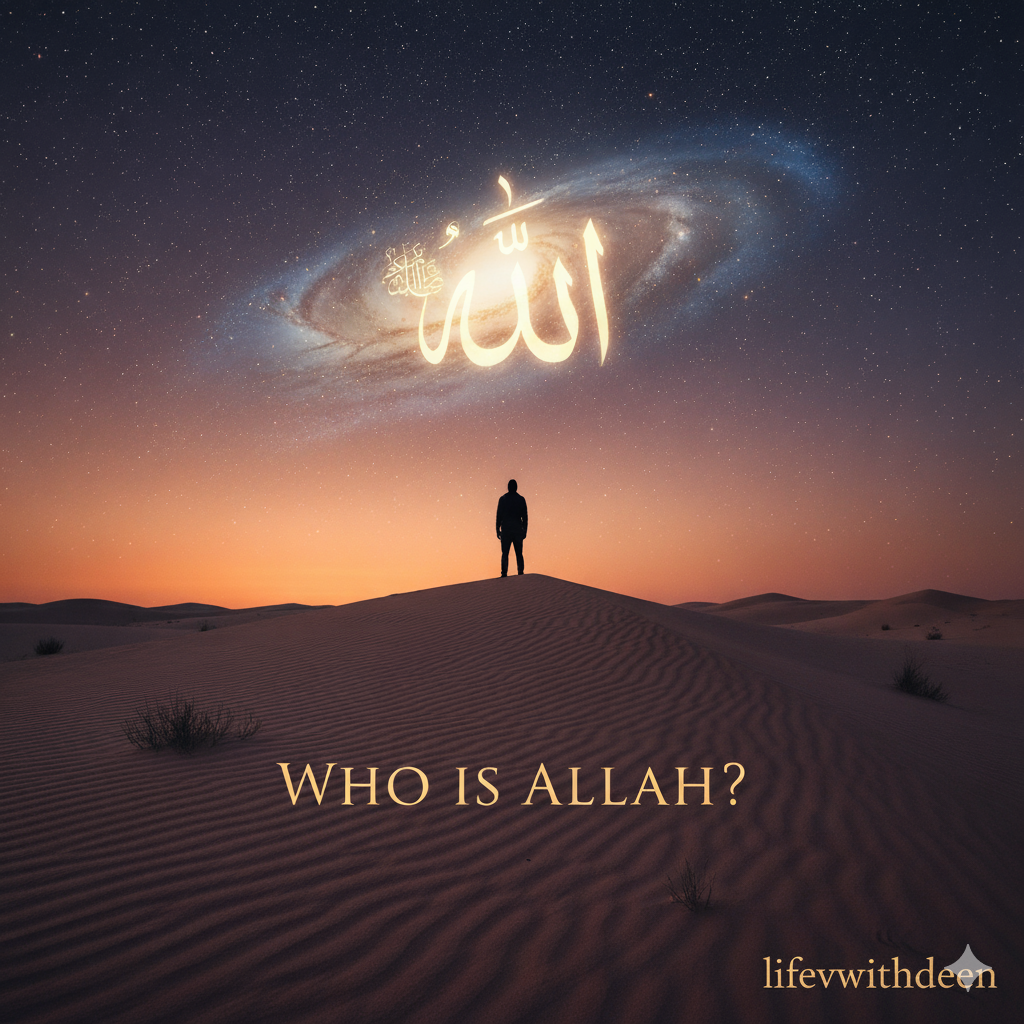
🙏The Name & Meaning of Allah
The word “Allah” is more than just a name; it expresses the uniqueness and absolute oneness of the Divine. According to one explanation, Who is Allah? “Allah is the name of the Supreme Being in the Arabic language. The word Allah is never used for any other being or thing.”
This is powerful: unlike many words for “god” in various languages (which can be plural, gendered, etc.), “Allah” is singular, without plural or variation, signifying the One True God.
✅ Practical reflection
- When you say “Allah”, reflect on the fact that you are speaking to the One who is unique, incomparable.
- For new Muslims: this simplicity in naming removes the need to think of multiple gods or versions of God — Islam points to one.
🌟The Oneness (Tawḥīd) of Allah
One of the most fundamental aspects of Islamic belief is the oneness of Allah — known as Tawḥīd. The Qur’an declares this in the beautiful and concise chapter Sūrah Al‑Ikhlāṣ (112):
“Say: He is Allah, [who is] One. Allah, the Eternal Refuge. He neither begets nor is born. Nor is there to Him any equivalent.”
Also, in Sūrah Al‑Ḥashr (59) :
“He is Allah — there is no god except Him: the King, the Most Holy, the Source of Peace, the Guardian over all things…”
These verses emphasise:
- There is no deity worthy of worship but Allah.
- He is unique and beyond comparison.
- He does not have offspring, nor was He born — so we avoid anthropomorphism.
- Nothing and no one is like Him.
✅ Practical reflection
- For youth: Who is Allah? It’s tempting to compare things in life (“He’s like God”, “She’s like God”) — but realise: no one and nothing is like Allah.
- For women: This recognition empowers you — you are created by the One who is perfect, and you are unique in your own way too.
- For new Muslims: This is your foundation — the oneness of Allah is the first thing to understand and live by.
🌍Allah as Creator, Sustainer and Knower
The Qur’an also emphasises that Allah is the creator, sustainer and knower of all things. As one commentary states:
“That is Allah your Lord! there is no god but He, the Creator of everything, Therefore worship Him, for He is Guardian over all things.”
And: “Vision perceives Him not, but He perceives (all) vision.”
From those verses we derive that:
- Allah brought everything into existence from nothing.
- He knows what is hidden and what is manifest.
- He watches over all creation; nothing escapes His knowledge.
- Hence, we are never “out of His sight” or “outside His care”.
✅ Practical reflection
- Whenever you feel isolated or unseen, remember: Allah sees you better than you see yourself.
- In your career or studies (as you are in IT / software), recognise that your knowledge and skills also come from Him. Use them as a means to serve Him and others.
- For new Muslims: Knowing this helps build trust (Tawakkul) — because Allah is in control even when you may feel uncertain.
❤️Allah’s Relationship with His Servants
What does Allah expect from us, and how does He treat us? Here are some key hadith and principles:
- The Prophet Muhammad (peace be upon him) asked: > “O Mu’adh, do you know what the right of Allah is upon His servants?” He said: “To worship Him alone and to associate none in worship with Him.” Then: “And do you know what their right is upon Allah?” He said: “Not to punish them if they do so.”
- Also: “The slave’s right on Allah is that He should not punish him who worships none besides Him.”
From these:
- Worship Allah alone (no shirk).
- When one worships sincerely, Allah’s right is mercy, not destruction.
- Allah’s mercy and justice both play a role.
- Our actions matter, but the relationship is also about love, hope, fear, and trust in Allah.
✅ Practical reflection
- In your daily prayers (Salah), in your blog writing, remind yourself: the worship is for Allah alone.
- Women often juggle many roles — wife, daughter, employee, student — but at the core: worship, remembrance, and service to Allah are central.
- For new Muslims: It’s okay if you make mistakes — Allah’s mercy is vast. The key is sincerity, returning, and doing your best.
🧠Why Knowing Allah Matters — for Youth & New Muslims
For youth : Who is Allah?
- In a world of peer pressure, distractions, “what’s next?”, knowing Allah gives you stability. When everything else changes, this truth remains: there is One who is your Creator and Sustainer.
- It shifts your identity: you’re not just defined by your job, phone, or social media image — you are a servant of Allah, honoured and responsible.
For women: Who is Allah?
- Many women face societal roles, expectations, balancing work and home, and sometimes undervaluation. Realising that only Allah truly counts reshapes your self-worth.
- Your relationship with Allah is personal, direct, and not mediated. You have direct access to Him — what amazing empowerment.
For new Muslims: Who is Allah?
- You might feel you are “starting from scratch” in faith — that’s okay. Begin with the simple but profound: Oneness of Allah, His mercy, your connection.
- Who is Allah? Embrace mistakes as part of growth. Knowing Allah means knowing you will keep improving, and He keeps guiding.
🔍 Common Misconceptions & Clarifications
- “Allah is just like other gods” – No. In Islam, Allah is unique, incomparable. The Qur’an states: “And there is none comparable unto Him.”
- “Allah has a partner or equals” – That is shirk (association), which Islam rejects. The right understanding of Allah excludes all partners.
- “Allah is distant or uninterested” – Rather, Allah is closer to you than your jugular vein (Qur’an 50:16). He is near, yet beyond human comprehension. The Qur’an says: “Vision perceives Him not, but He perceives vision.”
- “Allah’s mercy means I can do whatever I like” – Mercy is enormous, but worship and obedience are required. The hadith about rights above reminds us of that balance.
📖Practical Steps to Strengthen Your Relationship with Allah
- Start each day with dhikr (remembrance) of Allah. Even a short “Alhamdulillah”, “SubhanAllah”, “Allahumma barik” helps.
- Reflect on the names of Allah — e.g., Al-Rahman (Most Merciful), Al-Kaafi (The Sufficient), Al-Aleem (All-Knowing).
- In your work/studies: remind yourself lunchtime, breaks, meetings – you are doing them for Allah, seeking to make them a form of worship.
- For your blog: write posts that remind others of Allah’s presence, mercy, guidance — perfect space for spiritual wellness.
- For new Muslims: Build a simple routine — reading one small Qur’an portion, asking Allah for guidance, keeping company of good friends.
📝 Conclusion
Understanding who Allah is is not mere theology for textbooks — it affects our identity, our daily choices, our emotional wellness. As youth, women, or new Muslims, this knowledge gives you a firm foundation. You are not alone, you are not insignificant — you are a beloved creation of the One who is unique, merciful, powerful and ever-present.
May Allah grant you the understanding (nāfiʿ ʿilm), the strong connection (ẓuhūr in your heart) and the practice (ʿamal) that brings peace and guidance.
Ameen.