Introduction: Truth Is Often Lonely
Breaking the Idols: Standing for truth is rarely easy. When beliefs become traditions and falsehood becomes normal, speaking the truth feels like rebellion. Many people stay silent not because they agree with wrong, but because they fear rejection, ridicule, or loss.
The Qur’an presents a bold example of moral courage through the story of Prophet Ibrahim (AS) — a man who stood alone against an entire nation, not with violence, but with clarity, wisdom, and unwavering faith.
The incident of breaking the idols teaches us how Islam views truth:
Truth must be upheld, even when it stands against society.
A Society Built on Shirk
Prophet Ibrahim (AS) lived among people deeply attached to idol worship. These idols were not just objects; they were symbols of identity, culture, and power. Questioning them meant questioning the entire social order.
Yet Ibrahim (AS) dared to ask a simple but dangerous question:
“What are these statues to which you are devoted?”
(Surah Al-Anbiya 21:52)
Instead of reflection, his people responded with blind tradition:
“We found our forefathers worshipping them.”
This response reflects a mindset the Qur’an repeatedly warns against — following tradition without truth.
Challenging False Beliefs with Wisdom
Ibrahim (AS) did not insult his people. He did not mock them. He engaged their intellect. He exposed the weakness of idol worship through logic:
- Idols could not speak
- They could not hear
- They could not protect themselves
Allah quotes Ibrahim (AS):
“Do they hear you when you supplicate? Or do they benefit you, or harm?”
(Surah Ash-Shu‘ara 26:72–73)
Truth was presented calmly — but hearts blinded by pride refused to accept it.
The Bold Act: Breaking the Idols
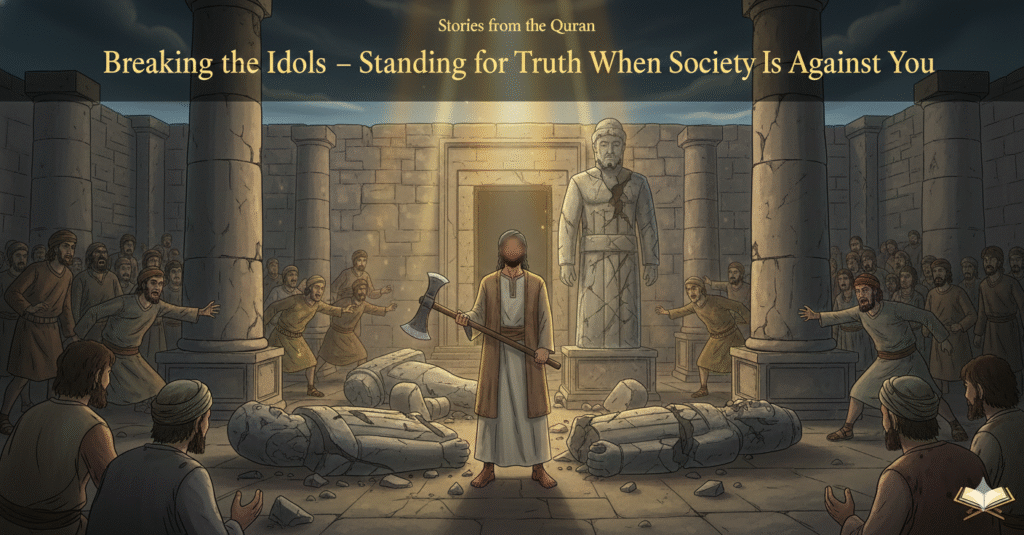
To awaken his people from heedlessness, Ibrahim (AS) took a bold step. He broke all the idols except the largest one and placed the tool with it.
Allah says:
“So he made them into fragments, except a large one among them…”
(Surah Al-Anbiya 21:58)
This was not an act of anger or chaos. It was a strategic message — a mirror held up to their beliefs.
“Ask Them If They Can Speak”
When the people returned and saw their idols destroyed, they were furious. They accused Ibrahim (AS), who calmly replied:
“Rather, this largest of them did it, so ask them, if they should be able to speak.”
(Surah Al-Anbiya 21:63)
For a moment, silence fell.
The Qur’an says:
“So they returned to [blaming] themselves…”
(Surah Al-Anbiya 21:64)
Truth touched their hearts — briefly. But ego soon took over.
When Pride Rejects Truth
Instead of accepting the truth, they turned against Ibrahim (AS). They chose to punish the truth-speaker rather than abandon falsehood.
This is a recurring human pattern:
- Truth exposes comfort
- Ego resists accountability
- Power silences honesty
They decided:
“Burn him and support your gods.”
(Surah Al-Anbiya 21:68)
Standing for truth came with a heavy price — but Ibrahim (AS) did not retreat.
Lessons from Breaking the Idols
1️⃣ Truth Must Be Spoken with Wisdom
Ibrahim (AS) used reason, not rage.
2️⃣ Majority Is Not Proof of Truth
Entire nations can be wrong.
3️⃣ Tradition Is Not Sacred If It Opposes Allah
Islam values truth over heritage.
4️⃣ Standing for Truth Requires Courage
Fear disappears when faith is strong.
5️⃣ Truth-Speakers Are Often Opposed
Rejection does not mean failure.
Relevance in Today’s World
Today, “idols” may not be statues, but they still exist:
- Blind social trends
- Materialism
- Ego and status
- Cultural practices against Islam
- Fear of public opinion
Standing for truth today might mean:
- Choosing halal over popularity
- Speaking honestly despite backlash
- Practicing Islam confidently
- Refusing to normalize wrong
The story of Ibrahim (AS) reminds us that truth never needs numbers to survive.
How to Stand for Truth Without Losing Balance
Islam teaches balance:
- Speak with wisdom
- Avoid arrogance
- Be patient with reactions
- Trust Allah with outcomes
- Never compromise core beliefs
Allah says:
“So remain on a right course as you have been commanded…”
(Surah Hud 11:112)
Conclusion: Truth Is Heavy, But It Frees the Soul
Breaking the idols was not just an event — it was a declaration. A declaration that truth deserves loyalty, even when the world resists it.
If you feel alone standing for what is right, remember:
- Ibrahim (AS) stood alone
- Allah stood with him
- And truth prevailed
🤲 A Short Dua
O Allah, grant us the courage to stand for truth, wisdom in our words, and firmness in our faith even when we stand alone.