Introduction: When Power Becomes a Responsibility
Power is one of the greatest tests Allah gives to humanity. Some people are tested with hardship, while others are tested with authority, influence, and control. History shows that power without faith often leads to corruption, but power guided by iman can become a source of justice and mercy.
The story of Dhul Qarnayn in Quran, mentioned in Surah Al-Kahf, presents a rare and inspiring example of a ruler who combined strength with humility, authority with accountability, and power with faith.
Who Was Dhul Qarnayn?
Dhul Qarnayn in Quran:The Qur’an does not specify the exact identity of Dhul Qarnayn, but it clearly describes his character and mission. Dhul Qarnayn was a ruler to whom Allah granted:
- Vast authority
- Strong resources
- Knowledge and means
- Ability to travel and govern
Allah says:
“Indeed, We established him upon the earth, and We gave him to everything a way.”
(Surah Al-Kahf 18:84)
This verse shows that Dhul Qarnayn’s power was a gift from Allah, not a personal achievement.
Traveling with Purpose, Not Pride
Dhul Qarnayn in Quran: Dhul Qarnayn traveled across lands — east and west — but unlike many rulers, he did not travel to conquer for ego or wealth. He traveled to establish justice and address the needs of people.
Wherever he went:
- He observed carefully
- He listened to people
- He judged fairly
- He remembered Allah
This teaches an important principle:
👉 Leadership in Islam is service, not dominance.
Justice Without Cruelty
Dhul Qarnayn in Quran: When Dhul Qarnayn encountered a people involved in wrongdoing, Allah gave him the authority to punish or forgive.
Allah says:
“As for one who wrongs, we will punish him. Then he will be returned to his Lord…”
(Surah Al-Kahf 18:87)
But Dhul Qarnayn did not misuse this power. He balanced justice with accountability and mercy, proving that true justice is firm but not tyrannical.
The Weak People and a Powerful Threat
Dhul Qarnayn in Quran: One of the most famous incidents in the story of Dhul Qarnayn is his encounter with a weak community threatened by Ya’juj and Ma’juj.
The people said:
“Indeed, Ya’juj and Ma’juj are great corrupters in the land…”
(Surah Al-Kahf 18:94)
They asked Dhul Qarnayn to build a barrier to protect them.
Leadership That Empowers, Not Exploits
Instead of demanding wealth or tribute, Dhul Qarnayn responded with humility:
“What my Lord has given me is better…”
(Surah Al-Kahf 18:95)
He involved the people in building the barrier, teaching them responsibility and cooperation.
This moment gives a powerful leadership lesson:
👉 A true leader builds people, not dependence.
A Wall Built with Effort and Faith
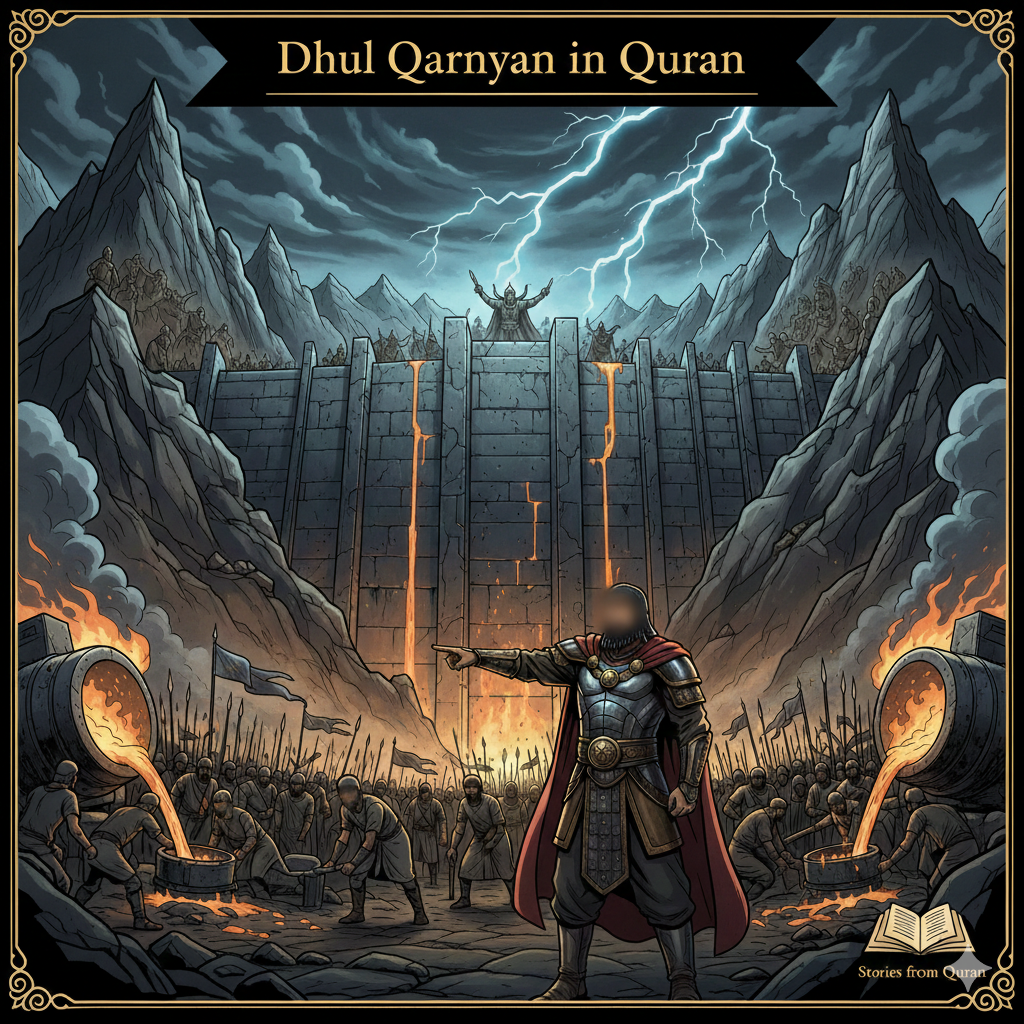
Using iron and molten copper, Dhul Qarnayn built a strong barrier that protected the people from corruption.
When the task was completed, he did not boast.
Instead, he said:
“This is a mercy from my Lord.”
(Surah Al-Kahf 18:98)
Despite his achievement, he credited Allah alone — the clearest sign of humility.
Long-Tail Lessons (Layer 2 Applied)
This story answers real-life questions like:
- how Islam views power and leadership
- what makes a just ruler in Islam
- using authority with accountability
- humility despite success
- leadership guided by faith
The Dhul Qarnayn in Quran teaches that power becomes dangerous when faith is absent, and beneficial when guided by Allah.
Key Life Lessons from Dhul Qarnayn
1️⃣ Power Is a Trust from Allah
Authority is given, not earned independently.
2️⃣ Justice Must Be Balanced
Firmness without cruelty defines Islamic justice.
3️⃣ Humility Protects Success
Dhul Qarnayn never claimed personal greatness.
4️⃣ Leadership Means Serving the Weak
True strength lifts others.
5️⃣ Achievements Belong to Allah
Success should increase gratitude, not pride.
Relevance in Today’s World
Today, people hold power in many forms:
- Leadership roles
- Wealth and influence
- Social media platforms
- Family or workplace authority
The story of Dhul Qarnayn reminds us:
👉 Power without accountability leads to corruption.
👉 Power with faith leads to justice.
How to Apply the Story of Dhul Qarnayn Today
- Use influence responsibly
- Credit Allah for success
- Protect the weak
- Avoid arrogance in leadership
- Remember accountability in the Hereafter
Allah says:
“That home of the Hereafter We assign to those who do not desire exaltedness upon the earth…”
(Surah Al-Qasas 28:83)
Conclusion: Faith Turns Power into Mercy
The story of Dhul Qarnayn shows us that Islam does not reject power — it disciplines it. When authority is combined with faith, justice prevails, communities are protected, and leaders become a source of mercy.
If Allah grants you influence today, remember:
- Dhul Qarnayn had power
- Dhul Qarnayn remained humble
- And Allah honored him for it
🤲 A Short Dua
O Allah, grant us humility in success, justice in authority, and faith that guides every responsibility we carry.