Introduction: When Blessings Turn into a Test
Many people assume that blessings will always remain as long as effort continues. Islam teaches something deeper: every blessing is a test, and how we respond to it determines whether it stays or disappears.
The People of the Garden in Quran, mentioned in Surah Al-Qalam, present a powerful reminder of what happens when gratitude is replaced by greed and generosity is replaced by selfish planning.
This story is not about farming alone — it is about hearts that forget Allah after receiving His favor.
Who Were the People of the Garden?
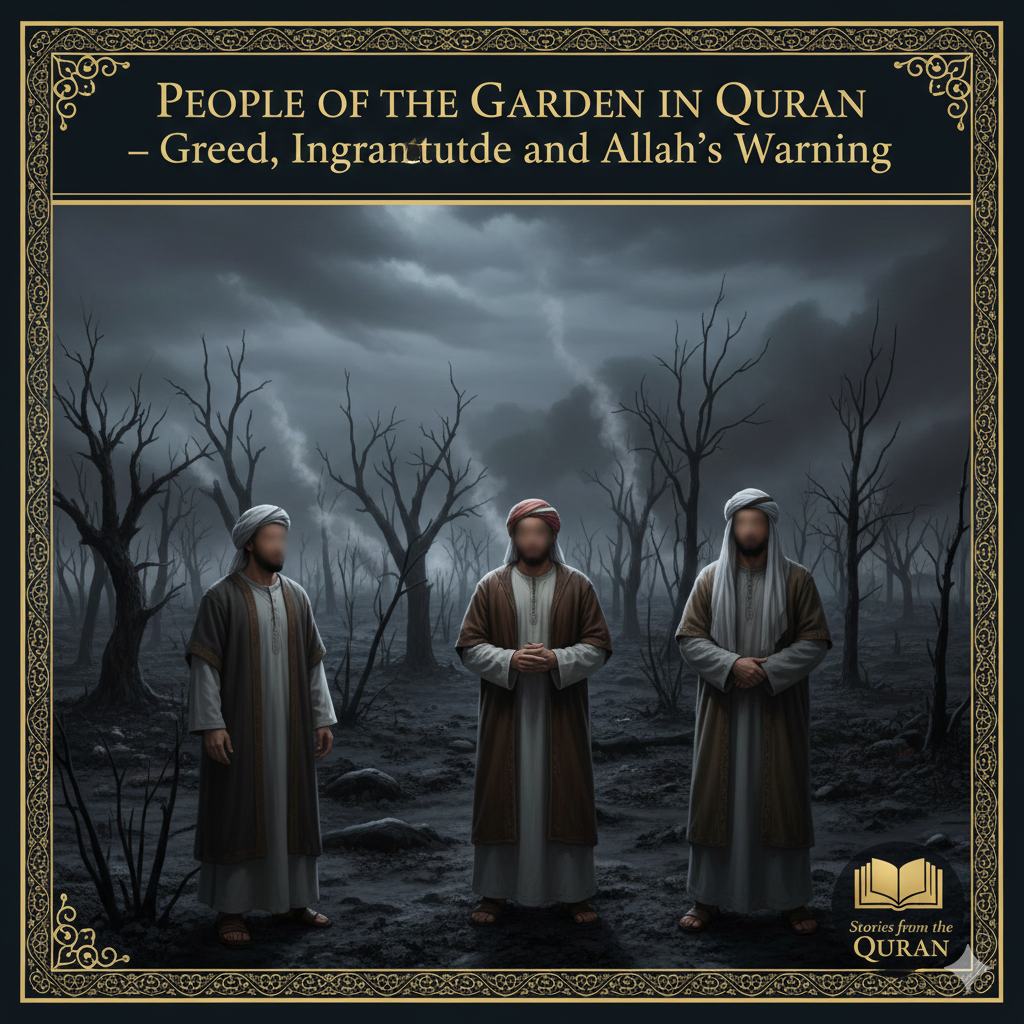
People of the Garden in Quran were brothers who inherited a fruitful garden from their righteous father. Their father used to:
- Harvest his crops
- Give charity to the poor
- Thank Allah openly
- Share Allah’s blessings
After his death, his sons decided to change the way things were done.
They wanted:
- All profit for themselves
- No share for the needy
- Early harvesting to avoid the poor
This shift was not financial — it was spiritual.
A Plan Made Without Allah
People of the Garden in Quran: The brothers secretly planned to harvest the garden early in the morning so that no poor person could ask for help.
Allah describes their mindset:
“When they swore to harvest [their fruit] in the morning, without making any exception.”
(Surah Al-Qalam 68:17–18)
They did not say In shaa Allah.
They did not remember Allah.
They trusted their plan, not their Lord.
👉 This is where the downfall began.
When Allah’s Warning Arrives Silently
People of the Garden in Quran: That very night, while they were sleeping, Allah sent His decree.
Allah says:
“So there came upon the garden an affliction from your Lord while they were asleep.”
(Surah Al-Qalam 68:19)
By morning, the garden was completely destroyed — burned, blackened, and lifeless.
No storm warning.
No chance to revise plans.
No opportunity to delay consequences.
Shock, Denial, and Realization
When the brothers reached the garden, they were confused:
“Indeed, we are lost.”
(Surah Al-Qalam 68:26)
At first, they thought they had gone to the wrong place. Then reality hit them.
“Rather, we have been deprived.”
(Surah Al-Qalam 68:27)
Only then did one of them remind the others:
“Did I not say to you, ‘Why do you not glorify Allah?’”
(Surah Al-Qalam 68:28)
Remorse arrived — but after loss.
Repentance After Loss
People of the Garden in Quran: The brothers finally acknowledged their wrongdoing:
“They said, ‘Exalted is our Lord! Indeed, we were wrongdoers.’”
(Surah Al-Qalam 68:29)
They turned to Allah in regret, hoping for forgiveness.
Allah then gives a powerful warning:
“Such is the punishment [of this world]. And the punishment of the Hereafter is greater…”
(Surah Al-Qalam 68:33)
This shows that worldly loss is often a wake-up call, not the final punishment.
Long-Tail Lessons (Layer 2 Applied)
This story answers real questions like:
- why greed removes blessings
- what happens when charity is neglected
- consequences of ingratitude in Islam
- how Allah tests wealth
- why saying In shaa Allah matters
The People of the Garden in Quran prove that Allah does not take blessings without warning — He takes them after arrogance replaces gratitude.
Key Life Lessons from the People of the Garden
1️⃣ Blessings Require Gratitude
Wealth without shukr is temporary.
2️⃣ Charity Protects Rizq
What you give for Allah never reduces wealth.
3️⃣ Planning Without Allah Brings Loss
Forgetting Allah invites failure.
4️⃣ Greed Destroys Barakah
More control often means less blessing.
5️⃣ Loss Can Be Mercy
Worldly loss may save the Hereafter.
Relevance in Today’s World
Today’s gardens look different:
- Businesses
- Careers
- Investments
- Talents
- Influence
Yet the test remains the same:
👉 Will success make us grateful or greedy?
The story warns that:
- Cutting charity
- Ignoring the needy
- Trusting plans over Allah
can silently remove barakah.
How to Protect Your Blessings
- Say In shaa Allah sincerely
- Give charity consistently
- Remember the poor in success
- Thank Allah openly
- Never assume blessings are guaranteed
Allah promises:
“If you are grateful, I will surely increase you.”
(Surah Ibrahim 14:7)
Conclusion: Barakah Lives Where Gratitude Lives
The story of the People of the Garden teaches us that Allah does not need to take blessings loudly. Sometimes, He removes them quietly — to teach, to warn, and to bring hearts back to Him.
If Allah has blessed you today, ask yourself:
- Am I grateful?
- Am I generous?
- Am I remembering Allah in my success?
🤲 A Short Dua
O Allah, protect us from greed, fill our hearts with gratitude, and never let our blessings distract us from You.