Questions in the Grave in Islam
Death is not the end of our journey—it is the beginning of our meeting with the realities of the Hereafter. One of the first events after burial is the questioning in the grave, a subject clearly mentioned in authentic Sunnah.
Many Muslims wonder:
- What are the questions in the grave?
- Who asks these questions?
- Will everyone be questioned?
- How can we prepare?
In this article, we will explore what the Quran and authentic Hadith teach about the questioning in the grave while avoiding speculation about matters of the unseen.
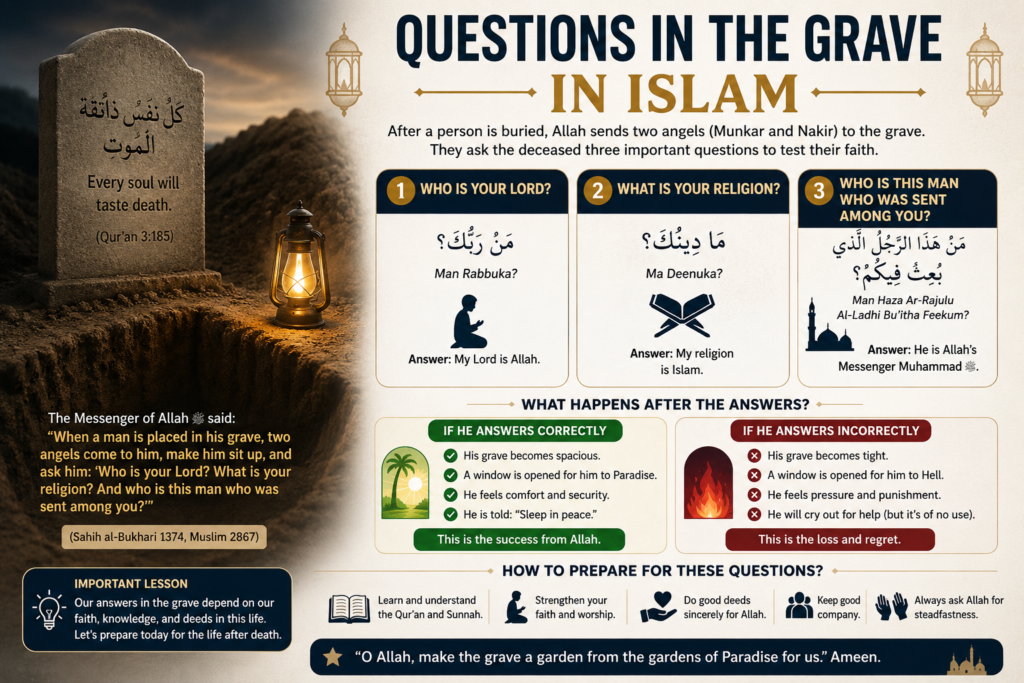
Does the Quran Mention the Questioning in the Grave?
The Quran does not list the three questions directly. However, scholars explain that Allah’s statement about making the believers firm includes this event.
Allah says:
“Allah keeps firm those who believe, with the firm word, in the worldly life and in the Hereafter…”
(Surah Ibrahim 14:27)
Many scholars, based on authentic hadith, explain that this firmness includes the believer being able to answer the questions asked in the grave.
Who Will Ask the Questions?
According to authentic hadith, two angels come to the deceased after burial.
They are known as Munkar and Nakir.
Questions in the Grave in Islam: The Prophet ﷺ described their questioning in authentic narrations recorded by scholars such as Imam Ahmad, Abu Dawud, and At-Tirmidhi. The narrations are regarded as authentic or hasan by many hadith scholars.
What Are the Three Questions?
Every accountable person will be asked questions concerning the foundations of faith.
1. Who is Your Lord?
The believer replies:
“My Lord is Allah.”
This answer reflects sincere faith, not merely memorized words.What Happens to the One Who Cannot Answer?
Authentic hadith describe that those who rejected faith or failed to respond correctly will not be able to answer the questions.
The narrations mention that hardship follows according to Allah’s justice.
At the same time, Muslims avoid judging specific individuals, because final judgment belongs to Allah alone.
2. What is Your Religion?
The believer answers:
“My religion is Islam.”
Islam is a complete way of life based on submission to Allah.
3. Who is Your Prophet?
The believer answers:
“Muhammad ﷺ is the Messenger of Allah.”
This answer reflects belief accompanied by following the Prophet ﷺ in worship and daily life.
What Happens to the Believer?
Questions in the Grave in Islam: Authentic hadith describe that when the believer answers correctly by Allah’s permission:
- The grave is expanded.
- Peace and comfort are granted.
- A window toward Paradise is opened for them.
- They await the Day of Judgment with hope.
The exact nature of these blessings belongs to the unseen, and Muslims affirm what has been authentically reported without imagining details beyond the evidence.
What Happens to the One Who Cannot Answer?
Questions in the Grave in Islam: Authentic hadiths describe that those who rejected faith or failed to respond correctly will not be able to answer the questions.
The narrations mention that hardship follows according to Allah’s justice.
At the same time, Muslims avoid judging specific individuals, because final judgment belongs to Allah alone.
Can Good Deeds Help?
The Prophet ﷺ repeatedly taught that righteous deeds benefit a believer.
Consistent acts of worship such as:
- Performing the five daily prayers
- Reading the Quran
- Speaking truthfully
- Giving charity
- Remembering Allah
- Repenting sincerely
all strengthen a believer’s relationship with Allah.
Ultimately, success comes only through Allah’s mercy and guidance.
How Can We Prepare for the Questions in the Grave?
Preparing is not about memorizing three answers.
Rather, it is about living those answers every day.
Ask yourself:
- Is Allah truly the center of my life?
- Am I living according to Islam?
- Am I following the Sunnah of Prophet Muhammad ﷺ?
The more sincerely a person lives these truths, the greater their hope of remaining firm by Allah’s permission.
The Dua of the Prophet ﷺ
The Prophet ﷺ used to seek Allah’s protection from the trial of the grave.
Among the authentic supplications is:
اللَّهُمَّ إِنِّي أَعُوذُ بِكَ مِنْ عَذَابِ الْقَبْرِ
Allahumma inni a’udhu bika min ‘adhabil-qabr.
Meaning:
“O Allah, I seek refuge in You from the punishment of the grave.”
This dua is authentically reported in Sahih al-Bukhari and Sahih Muslim as part of the supplications the Prophet ﷺ taught before ending the prayer.
Lessons We Learn
1. Faith Must Be Lived
The questions are not simply about information—they relate to genuine belief and practice.
2. This Life Is Our Preparation
The answers we hope to give in the grave are reflected in the choices we make today.
3. Allah Alone Grants Firmness
No one succeeds through their own strength alone. We constantly ask Allah to keep our hearts firm upon the truth.
Final Reflection
The questioning in the grave is one of the first realities every person will face after death. It reminds us that this life is a test and that our relationship with Allah should be built on sincere faith, righteous deeds, and obedience to His Messenger ﷺ.
Rather than allowing this topic to fill us with despair, it should inspire us to renew our faith, seek forgiveness, and prepare for the meeting with Allah through consistent worship and good character.
May Allah make us among those who remain firm in this life and in the Hereafter, grant us ease in the grave, and admit us into Jannatul Firdaus. Ameen.
Frequently Asked Questions
What are the three questions in the grave?
According to authentic hadith, the questions concern:
- Who is your Lord?
- What is your religion?
- Who is your Prophet?
Who asks the questions in the grave?
Authentic narrations mention that two angels, known as Munkar and Nakir, question the deceased.
Does the Quran mention these questions?
The Quran does not list the three questions explicitly. However, scholars connect Surah Ibrahim (14:27) with the believer being made firm during this trial, based on authentic hadith.
How should Muslims prepare?
By strengthening their faith, performing righteous deeds, following the Sunnah, repenting sincerely, and asking Allah to keep them steadfast.