Who Are Munkar and Nakir? The Angels Who Question the Dead in Islam
Introduction
Every person who leaves this world begins a journey into the Hereafter. One of the earliest stages of that journey is the questioning in the grave.
Many Muslims have heard the names Munkar and Nakir, but questions often arise:
- Who are they?
- Are they mentioned in the Quran?
- What exactly do they do?
- Should Muslims fear them?
Islam teaches us about the unseen (Ghayb) only through authentic revelation. Therefore, our understanding of Munkar and Nakir should come from the Quran and the authentic Sunnah, not from stories or cultural traditions.
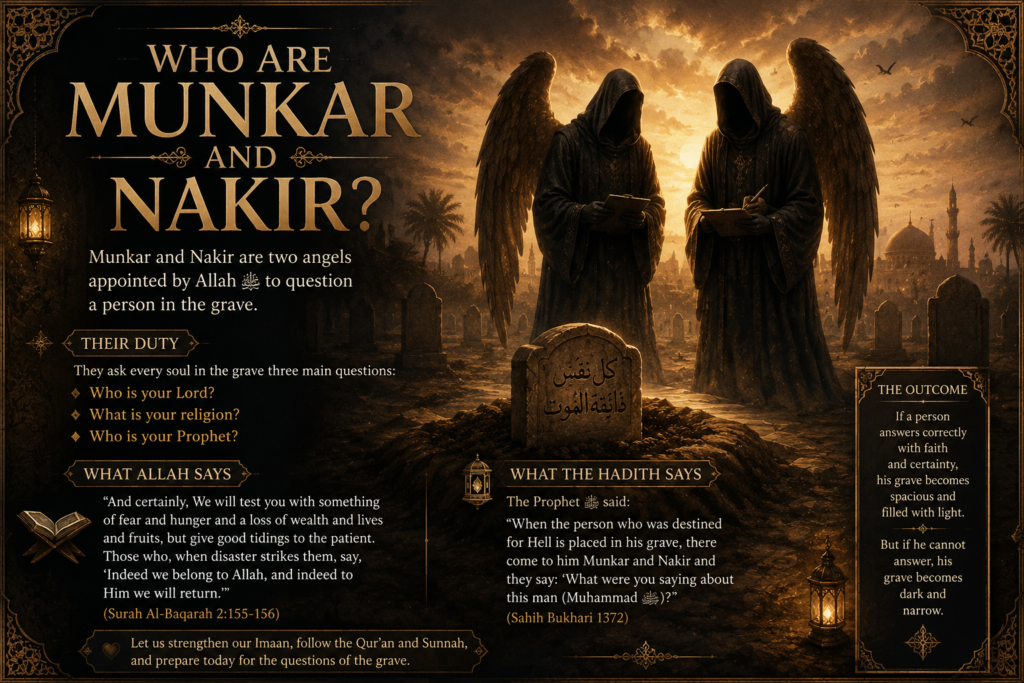
Who Are Munkar and Nakir?
Munkar and Nakir are two angels appointed by Allah to question the deceased after burial.
Their role is not to decide who enters Paradise or Hell. Rather, they carry out Allah’s command by questioning people about the foundations of their faith.
The questioning is one of the first tests a person experiences after death.
Does the Quran Mention Munkar and Nakir?
The Quran does not mention the names “Munkar” and “Nakir” directly.
However, the Quran speaks about the life after death, Barzakh, and Allah granting firmness to the believers.
Allah says:
“Allah keeps firm those who believe, with the firm word, in the worldly life and in the Hereafter…”
(Surah Ibrahim 14:27)
The Prophet ﷺ explained through authentic Hadith that this firmness includes the believer during the questioning in the grave.
This is an excellent example of how the Quran and Sunnah complement one another.
Where Do We Learn About Munkar and Nakir?
The details about these angels come from authentic Hadith.
Among the narrations are reports found in:
- Jami’ at-Tirmidhi
- Sunan Abi Dawud
- Musnad Ahmad
Hadith scholars have authenticated or graded many of these narrations as hasan or sahih.
What Do Munkar and Nakir Ask?
According to authentic narrations, the deceased is questioned about the foundations of faith.
The questions are:
1️⃣ Who is your Lord?
The believer replies:
“My Lord is Allah.”
2️⃣ What is your religion?
The believer replies:
“My religion is Islam.”
3️⃣ Who is your Prophet?
The believer replies:
“Muhammad ﷺ is the Messenger of Allah.”
These are not simply questions of memory.
They reflect whether a person sincerely believed and lived according to these truths during their lifetime.
What Happens to the Believer?
Authentic Hadith describe that, by Allah’s permission, the believer answers correctly.
Then:
- The grave is widened.
- Comfort is granted.
- A window toward Paradise is opened.
- The believer awaits the Day of Judgment with hope.
The exact reality of these blessings belongs to the unseen, and Muslims affirm what Allah and His Messenger ﷺ have informed us without speculating further.
What Happens to the One Who Cannot Answer?
The authentic narrations also describe that those who rejected faith or failed this test are unable to answer correctly.
They face hardship according to Allah’s perfect justice.
At the same time, Islam teaches us not to judge the final state of specific individuals. Ultimate judgment belongs to Allah alone.
Can We Prepare for This Questioning?
Yes.
Preparation begins in this life.
The answers in the grave are connected to how we live today.
Some practical ways to prepare include:
✅ Worship Allah sincerely.
✅ Perform the five daily prayers.
✅ Read and reflect upon the Quran.
✅ Follow the Sunnah of Prophet Muhammad ﷺ.
✅ Seek forgiveness regularly.
✅ Fulfill the rights of others.
✅ Make sincere repentance before death.
The goal is not merely to know the answers but to live by them
Common Misconceptions
❌ Misconception 1
Everyone knows exactly how Munkar and Nakir look.
Reality: Authentic Hadith mention aspects of their appearance, but Muslims should avoid exaggerated descriptions that are not supported by reliable evidence.
❌ Misconception 2
Memorizing the three answers is enough.
Reality: The questioning is about sincere faith, not memorization alone.
❌ Misconception 3
Only very sinful people are questioned.
Reality: The questioning is part of the life of the grave as described in authentic narrations. Success comes through Allah’s mercy and steadfast faith.
Lessons We Learn
Faith Must Be Real
Islam is more than words.
It is belief shown through worship, obedience, and good character.
Prepare Before Death
No one knows when death will come.
Every day is an opportunity to strengthen our relationship with Allah.
Ask Allah for Steadfastness
The Prophet ﷺ regularly made dua and taught believers to seek Allah’s protection from the punishment of the grave.
We should also make this a regular part of our lives.
Final Reflection
Munkar and Nakir remind us that our journey does not end with death. After we leave this world, each of us will stand before realities that Allah and His Messenger ﷺ have informed us about.
Rather than allowing these reminders to create despair, they should encourage us to strengthen our faith, increase our worship, and prepare sincerely for the meeting with Allah.
May Allah make us steadfast in this life and in the Hereafter, grant us the correct answers by His mercy, and admit us into Jannatul Firdaus.
Ameen.
📌 Key Takeaways
- Munkar and Nakir are two angels appointed by Allah to question the deceased.
- Their names are found in authentic Hadith, not directly in the Quran.
- They ask about a person’s Lord, religion, and Prophet.
- Success comes through sincere faith and Allah’s mercy.
- Preparing for this questioning means living according to Islam every day.
❓ Frequently Asked Questions
Who are Munkar and Nakir?
Munkar and Nakir are two angels who question the deceased in the grave about the foundations of their faith, as described in authentic Hadith.
Are Munkar and Nakir mentioned in the Quran?
Their names are not mentioned directly in the Quran. Their role is explained in authentic Sunnah, while verses such as Surah Ibrahim (14:27) are understood by scholars alongside these hadith.
What questions do Munkar and Nakir ask?
According to authentic narrations, they ask:
- Who is your Lord?
- What is your religion?
- Who is your Prophet?
How can Muslims prepare?
By strengthening faith, praying regularly, following the Sunnah, repenting sincerely, remembering Allah, and striving to live according to Islamic teachings.